Friday, March 12, 2010
Thursday, March 11, 2010
"Notes on a New Major: New Concepts in Sales, Merchandising"

Notes on a New Major: New Concepts In Sales, Merchandising
by Elsa F. Shain
Cinemation Industries, Inc., a new film distribution and production company which is putting into effect flexible and imaginative sales concepts in dealing with exhibitors, will soon announce a unique method of financing. The company, it was stated, is considering plans to apply at some future time for listing on one of the major stock exchanges. CII is not a conglomerate and has no mergers in the offing.
Cinemation Industries’ shares are traded over-the-counter presently. Their published trading range last week was 4-7/8; 4-1/2; and 4-1/4. In contrast, last week’s published accounts of trading prices of shares of Cinerama and Allied Artists Pictures, both of which are listed on the American Stock Exchange, were Cinerama (96,000 shares) – 4-/14; 2-7/8; and 3-3/4; Allied Artists – 3-1/8; 2-7/8; and 3.
Jerry Gross, Cinemation’s 29-year-old president and Harold Marenstein, vice-president, sales, conducted a luncheon meeting with the N.Y. trade press on Friday (28) at which the company’s emergence as a major distribution-production company was stressed and organization and policies were delineated. The meeting was also attended by Jess Wolff, financial v.p.; John J. O’Rourke, director of advertising, publicity, and exploitation; Alan M. Schachter, exploitation manager; and other company staffers.
Cinemation is at present in operation with 30 features, representing a negative value of about $10,000,000 for release in the year ahead; and plans for about 20 features a year with $3-$5 million being invested for current and future production. The company, which headquarters at 250 W. 57th Street, N.Y.C., has set up six division headquarters with more branches to follow as needed.

New Sales Concepts
“Our emergence into a major company is a significant factor in taking up the slack being felt by exhibitors as established majors retrench, reorganize, and severely cut production output,” Gross declared at the press luncheon.
“Will you elaborate on the statement that the company hopes to achieve a closer working relationship with exhibitors and that your structure and sales concept are different. What’s so different?” asked a reporter.
“My association with Cinemation is the culmination of 35 years of dreaming of having a perfect sales force,” replied sales chief Marenstein. “I started with the majors, then went with the independents…I always dreamt of some day having six to eight professional and experienced film men who know their territory, know every exhibitor, would be prepared to deal with each exhibitor and discuss his problems with him. Many of the problems in our industry are due to lack of communication. Sometimes the terms have been too onerous, and the exhibitor had to devise methods to protect himself against them. My idea was we would acquire a series of pictures; would work with the exhibitor and put a picture on the screen, play it, then sit down and talk. If he is hurt, we will discuss it; we are not going to demand before he plays a picture that he commit himself. Our men are ready to sit down with an independent or circuit exhibitor and discuss each picture individually. We are here to help the theatre man, not hurt him."
Not a One-Shot Company
GROSS: We are not a one-shot company – a company that has a picture and forces its terms upon exhibitors. I don’t know of any other industry where there is so much infighting. We have to make for a relationship which is more cohesive. We are producing pictures for a mass market – an audience of 35 million; those 35 million people don’t make one audience. They are fragmented into four or five groups. We don’t make pictures that can cover the broad spectrum of all audiences. Except for a James Bond picture, very few pictures run the gamut of all audiences. Very few pictures do well in all parts of the country. We figure each picture has a definite audience we aim it for…Sexploitation pictures are definitely on the decline. The general audience is still interested in seeing a picture with basic story values that are entertaining.
Q: You mean you are going out of the sexploitation business?
MARENSTEIN: Basically, we are staying in the motion picture industry. You have seen our industry go through many cycles. American taste changes constantly. The policy of Cinemation Industries is to try and determine what the public wants and be there fastest with the mostest. You won’t be able to go back to the standards of 1927 and have films that ignore sex – but you no longer can sell sex per se. It must be inherent in the plot. “Inga” and “Fanny Hill” were probably at the peak of the cycle of sex-art films. Large American audiences reached out for something they hadn’t seen before. The real reason for the success of foreign films was that they treated sex and human relations more honestly than American films did at that time. Films are international.

Production Plus Acquisitions
GROSS: Of approximately 150 features to be released in the next nine months, about two-thirds have been produced outside of the U.S. There are many reasons for that, mostly economic.
Q: When you say you will follow with 20 pictures, I assume you will acquire some.
GROSS: Yes, we are involved in negotiation for several pictures now. Seven or eight pictures will be our own production; seven or eight will be acquisitions or co-productions. $5,000,000 doesn’t seem like a lot for 20 pictures, but with some, complete financing is not involved; $3-5,000,000 is our share. We intend to make our pictures predominantly in California. Alan Riche (executive in charge of West Coast production) is currently dealing with 10-15 writers. Three productions are under way. A “horror” picture is shooting now. Budget? About $200,000. Two other productions are ready to roll with budgets of $400,000-$500,000.
Q: In other words, in 1970 your company is going ahead with its own production for the first time?
GROSS: We have been in production with five pictures since 1965 – three currently under way, eight all ready to go.
Q: Do expansion plans also include a change in your philosophy of film-making?
GROSS: We really do run the gamut with all types of films from classic, prestigious items to “Fanny Hill” – even animation with “The Magic Bird.” We will be doing pictures that set trends and follow trends.
Youthful Cinemation president Jerry Gross is himself a film-maker and film buff. He has risen to his present position the hard way. At 18, he was a stevedore; at 20, a truck driver; at 22, with his own savings of $7,000 plus $50,000 he was able to raise, he made “Girl on a Chain Gang,” which he sold directly to theatres and finally to a film company for $150,000. His associates praise his business acumen and showmanship and his retentive mind, which has an apparently infinite capacity for storing away relevant figures and facts concerning the film industry. He has demonstrated a canny aptitude for acquiring a film everyone else has turned down – such as “Inga” – and, with the addition of new sequences, re-editing, shifting sequences around, changing the music score, making it into quite a different product. “Inga” has grossed $1,800,000 to date. Others: “Fanny Hill,” $4-$4,200,000; “Female Animal,” $1,200,000. Cinemation is reissuing “Africa Addio” under the title “Africa Blood and Guts.” The original running time of almost two hours has been cut to 82 minutes. Gross has edited out all political sequences, leaving the meat of the film – the “blood and guts.”

“Basically, my policy is we open pictures, and even in the opening engagements they are to be considered as test engagements,” Gross explained. “We re-edit and re-cut a picture after it’s out in release.” Even “Whirlpool,” which is a hit at the Cinerama Theatre, New York, may undergo minor changes.
[International Motion Picture Exhibitor, 9/2/1970, p. 13-14]
Wednesday, March 10, 2010
The Endangered List (Case File #66)

RUN BEFORE THE WIND (1972)
Starring
Jean Yves
Toko Maki
Susan Rowland
Written, produced and directed
by
Brud Talbot
Executive producer
H. Stewart Bigger
Music by
William S. Thomas
A Jerry Gross presentation
of a Dana Films Ltd. production
Released by Cinemation Industries
MPAA rating: R
Starring
Jean Yves
Toko Maki
Susan Rowland
Written, produced and directed
by
Brud Talbot
Executive producer
H. Stewart Bigger
Music by
William S. Thomas
A Jerry Gross presentation
of a Dana Films Ltd. production
Released by Cinemation Industries
MPAA rating: R
"True life experiences of an amateur sailor who undertook a perilous 6,000-mile sea voyage from San Francisco to Tokyo." [Boxoffice, 12/13/1971, p.9]
Tuesday, March 09, 2010
Mystery Movies: THE FACADE and ILLUSIONS

Since this is shaping up to be a Cinemation Industries/Jerry Gross week here at the Temple, I thought I'd send out the call for more information on this intriguing mid '70s double bill from the Gross man: THE FACADE, featuring Max Von Sydow "in his first motion picture since THE EXORCIST" (but surely something that was shot before it), and the equally obscure co-feature ILLUSIONS, co-starring James Coco and Marcel Marceau. Any ideas?
Labels:
CINEMATION INDUSTRIES,
JERRY GROSS,
MYSTERY MOVIES
Monday, March 08, 2010
"Cinemation Industries -- The New Major"

[International Motion Picture Exhibitor, September 2, 1970, p.1-4]
What constitutes a major film company? Reasonable criteria might be a sizeable investment in future film negative value, the ability to produce and deliver to market a regular flow of feature films, and the capital to keep that product flow coming over a period time. Cinemation Industries, Inc., qualifies as a new major film distribution and production company in full operation on every one of these points.
The company estimates that it has some $10 million in negative value in 30 features for release in the year ahead, approximately 20 features a year to follow, and $3 to $5 million being invested for current and upcoming production.
Another positive stimulus that Cinemation has going for it is an enviable track record at theatre boxoffices. While many of the so-called majors were writing off large negative costs and paring down operations and personnel, Cinemation Industries has distributed a successful string of releases, at the same time adding top sales and production talent to its team to aid in guiding future operations.
Cinemation Industries’ president is 29-year-old Jerry Gross, who has surrounded himself with some of the most experienced veterans from all the major film companies, whose average age is about 20 years more than his own.

In a trade press luncheon held last Friday (August 28), Gross was joined by his top company executives, Harold Marenstein, vice-president, sales, and Jess Wolff, financial vice-president. They provided full details relating to the company’s organization and policies.
“The most significant thing we wish to stress,” stated Gross, “is that our emergence into a major company is a significant factor in taking up the slack being felt by exhibitors as established majors retrench, reorganize, and severely cut production output.”
Marenstein points out that Cinemation Industries was structured with new sales concepts to form a closer working relationship with exhibitors by dealing with them at the grass roots levels through distribution “pros,” providing quick decisions and maintaining a “friendly posture” in reviewing any decisions and engagements.
To accomplish its sales drive and handle its expanding release schedule, Cinemation Industries, with headquarters at 250 West 57th Street, New York City, will coordinate through six division headquarters strategically located in the important market centers of the country. More branches will be added as the need demands and manpower becomes available, based on recommendations of divisional managers.

The sales organizational breakdown has Jerome Sternlieb headquartered in New York as eastern division manager, with supervision over areas including New York, Boston, New Haven, Albany, Buffalo, and Philadelphia. Albert L. Kolitz is western division manager with headquarters at 291 S. La Cienega Blvd., Beverly Hills, California, and supervision over Los Angeles, Seattle, Portland, Denver, Salt Lake City, and San Francisco. Jack Eckhardt, Midwest division manager with Chicago headquarters at 203 N. Wabash Avenue, will direct sales operations for Chicago, Des Moines, Omaha, Minneapolis, Milwaukee, and Detroit.
Murray Becker recently joined the company as central division manager with headquarters in Washington, D.C., and will supervise Washington, Indianapolis, Cincinnati, Cleveland, and Pittsburgh areas. Edmund C. DeBerry is southwest division manager, headquartered at 5000 S. Ervay Boulevard in Dallas, with supervision over Dallas, Kansas City, St. Louis, Oklahoma City, New Orleans, and Memphis. Thomas A. Lambert, headquartered at 222 S. Church Street, Charlotte, will supervise the Charlotte, Atlanta, and Jacksonville territories.
Ralph Kinsler is branch manager for Los Angeles, and Edward Richter is branch manager for New York. Brian L. Geller is national print controller and sales representative in the New York home office. Reg R. Wilson, Prima Films, Inc., represents Cinemation Industries in Canada with headquarters in Toronto at the King Edward Sheraton Hotel.
One of the major sales policies pointed out by Marenstein is that, though there might be broad general sales policies on its product, complete autonomy will be given for the first time to division managers to set sales policies and to complete deals without home office approvals.

“Since our sales executives are all top pros and they are constantly dealing on grass roots levels with better understanding of local situations, we feel they are fully competent to make the decisions without referring to the home office,” stated Marenstein.
With 30 pictures on Cinemation Industries’ release schedule, Gross pointed out that his company is going all out to cover the full spectrum of product to appeal to every segment of the movie-going audience. Many of the company’s recent and current releases have been sex comedies which proved to be big money winners. Gross points out that, by riding the crest of the wave of popularity of such pictures, there has been a large flow of cash to contribute to the ambitious all-around production now contemplated as well as to the rapid expansion of his company. These pictures included “Fanny Hill,” which the company reports has grossed more than $4 million, and the highly successful “Female Animal” and “Inga.”
Gross is a great believer in using the big promotional sell and follows much of the original methods of Joseph E. Levine and the late Mike Todd with additional twists of his own.
“Selling a picture is just as important as making it,” Gross claims. “Showmanship is essential in today’s marketing more than ever before. We spend a great deal of time and money preparing the right campaigns and exploitation as well as providing the promotional tools for exhibitors.”
John J. O’Rourke, director of advertising, publicity and exploitation, works closely with Gross and Marenstein in developing campaigns and material. Alan M. Schachter is exploitation manager.

On the production end, Gross recently appointed Alan Riche, formerly a top agent with Creative Management Associates and the developer of many successful writers and projects, as executive-in-charge of west coast production. He is currently involved in working with several young writers developing screenplays, and Cinemation Industries will soon reveal new projects underway. On the east coast, Miss Constance Hipwell is Gross’ assistant in charge of production and story development.
“We are currently co-producing with established filmmakers and will help in the creation of new film projects as well as to finance and acquire completed films,” Gross said.
There are three productions currently underway for Cinemation Industries and eight more ready to go. One of the first productions to go before the cameras, in late fall in California, will be “All the Kind Strangers,” an Alfred Hitchcock-type psychological melodrama which James Nelson will produce with Christopher Lewis, Loretta Young’s son, making his directorial bow.
Gross, accompanied by Marenstein, covers all the worldwide production centers including Hollywood, London, Paris, and Rome in a constant search for acquisitions, production projects, and new talent.
The company’s chief executive officer has new production financing ideas which, because of current talks, he is unable to reveal at the time, but he did say: “I feel that out industry has a long way to go in developing new and better means of financing. We believe that we have some answers.”
There is a “go-go” spirit in this new organization – a bright spot in a seemingly dark moment in film history. Cinemation Industries is building on its solid, successful base and stands out as a new major source for product. The goal of the company is to leave its mark of success at America’s boxoffice.

Sunday, March 07, 2010
One-Sheet of the Week: FROM EAR TO EAR (1971)

LES COUSINES (1970)
U.S. release in 1971 as FROM EAR TO EAR
Also known as THE COFFIN and THE FRENCH COUSINS
Sunday, February 28, 2010
Saturday, February 27, 2010
Friday, February 26, 2010
Wednesday, February 24, 2010
GAME SHOW MODELS and THE BOOB TUBE screening this Friday @ The Cinefamily!

Cultra Video & Temple of Schlock Present
"The Art of Exploitation"
Cinefamily @ The Silent Movie Theatre
611 North Fairfax Avenue
Los Angeles, CA 90036-1714
(323) 655-2510
Friday, February 26th, 2010 -- Another hot triple bill!

1. GAME SHOW MODELS (a.k.a. GAME SHOW and TEENAGE MODELS) - 8:00pm
Directed by David Neil Gottlieb, 1977, 35mm, 88 min.
Having started off life as the off-kilter AFI-funded art film THE SEVENTH DWARF, GAME SHOW MODELS is a unique beast, reconciling the nitty gritty of the music biz with a bunch of outta-left-field nudity and assorted sleaze grafted on at the eleventh hour. Stuart is a PR firm exec whose task is to help usher in a childish and churlish new singing starlet; he discovers that the entertainment biz ain't what it's cracked up to be after he beds her and she gets all weird, and after his co-workers start brandishing guns and making uncomfortable sexual advances on him! Whether The Seventh Dwarf was never fully finished, or whether it was purchased and re-cut with new footage, we'll never know -- but what's evident is that there's some haphazardly inserted scenes featuring a sex-themed game show (hosted by Dick Miller!), on which bearded professor-like contestants fondle naked ladies through glory holes and then later screw them while standing up. Y'know -- the usual. Featuring inexplicable cameos by film critic Charles Champlin and jazz cat Willie Bobo, and a bewildering downtown L.A. mime interlude, GAME SHOW MODELS is a roaster of a rare breed.

2. THE BOOB TUBE - 9:45pm
Directed by Christopher Odin, 1975, 35mm, 82 min.
The whopping success of the 1974 television parody sketchfest THE GROOVE TUBE ushered in a slew of quickie, uneven sex-filled clones, but none of them went the extra distance in getting so queerly specific as THE BOOB TUBE, which exclusively covers the soap opera sweet spot. Composed of a phony daytime drama concerning a studly doctor and all the nymphets that want a bonk from his reflex hammer, the film is filled with the usual ludicrous plethora of twists and turns the genre calls for, and is periodically interrupted by some zany and naughty commercials. THE BOOB TUBE's charm comes from its cast's sincere attempts to play it all straight-faced, and it also scores points for being puerile, witty and raunchy all at the same time.

Plus!
Our mystery third feature is an R-rated drive-in comedy co-starring Rosanne Katon!
Tickets - only $10.00!
Buy Tickets
Sunday, February 21, 2010
Saturday, February 20, 2010
The Endangered List (Case File #64)

VALLEY OF BLOOD (1973)
Starring
Penny DeHaven
Ernie Ashworth
Zeke Clements
Wayne Forsythe
Rita Cristinziano
Joseph Turner
Herman Floyd
Directed by
Dean Turner
Written by
Wayne Forsythe
Produced by
John Daly
Photographed
by
Craig Faulkner
Ron Evans
John Evans
Music by
Don Green
Mica Productions
Running time: 64 minutes
a.k.a. LEGEND OF VALLEY OF BLOOD
More information
THE CINEHOUND FORUM
TURNER CLASSIC MOVIES
Friday, February 19, 2010
TIME OF THE EAGLE (a.k.a. THE DEVIL'S CLONE) on YouTube
A few weeks ago I was about to start looking for information on William Dial's thriller TIME OF THE EAGLE (a.k.a. THE DEVIL'S CLONE) for a possible "Endangered List" entry when I realized that the only existing copy of the movie had been put on YouTube, in its entirety, by producer Larry J. Gardner! You can find a link to the movie HERE, from Mr. Gardner's website. I haven't watched the movie yet, but I've included a few articles about its production below.

TIME OF THE EAGLE (1978)
Starring
Stuart Culpepper
Grace Zabriskie
Jim Peck
Jerry Colbert
Donna Percival
Mike Silver
Ron Campbell
David Hayman
Written and directed
by
William Allen Dial
Produced by
Larry J. Gardner
and
Stephen P. von Hagel
Executive Producer
Conley Jones
Director of Photography
Jere Snyder
Released by Omni Pictures in 1979 as THE DEVIL'S CLONE
Running time: 90 minutes
MPAA rating: R

‘Eagle’ Post-Production Work Nearing Completion
RALEIGH – Final editing of “Time of the Eagle,” an Audiofonics production, has been finished and the score is scheduled to be completed tomorrow (31) in Atlanta by Stephen P. von Hagel of Audiofonics and Pete Caldwell at Doppler Studios. Jim Ellis and Steve Hulse have composed the music.
The film was written and directed by Atlanta talent William Allen Dial and financed by Easy Productions of Greensboro, headed by Conley Jones, executive producer. Featured in the film are Atlanta stars Stuart Culpepper, Grace Zabriskie, Jim Peck and model Donna Percival. Audiofonics has headquarters at 1101 Downtown Blvd. here in Raleigh.
The story of “Time of the Eagle” begins with the present-day life of William Christopher, a man damaged by years of captivity under the Nazis as a young American G.I. and plagued by his distorted remembrances of those times. Christopher is kidnapped and taken to Argentina, where the Nazi organization has grown to monstrous international proportions. Christopher somehow is the key element in their quest to establish the Fourth Reich and gain global power.
Hans Zalman, a West German Interpol agent portrayed by North Carolina-born actor Jerry Colbert, has been monitoring the activities of the Neo-Nazis and pursuing Nazi war criminal Ernest von Stott. Zalman, blinded with a vendetta for the death of his father and a German that he loved, attempts to rescue Christopher and halt the progress of the Nazis.
Although several international distributors have shown interest in “Time of the Eagle,” no distribution rights have been awarded, pending completion of post-production work.
[Boxoffice, May 30, 1977, p.SE1, SE3]
Raleigh Producers Film Action-Packed Adventure
RALEIGH, N.C. – A mad Nazi scientist makes the local Research Triangle Park’s futuristic Burroughs-Wellcome building his headquarters, ten torches and 300 candles light an occult ceremony at Pullen Park and a kidnap victim is whisked to a waiting jet at Raleigh-Dunham Airport that spirits him away to South America.
Implausible?
Not in the minds of two local filmmakers who have just finished editing a locally produced film that spins just such a tale.
The film, “Time of the Eagle,” was produced by Stephen P. von Hagel and Larry J. Gardner of Audiofonics, a commercial film and sound studio.
But, as von Hagel puts it, “Raleigh produced this film. It was really made here in North Carolina.”
Von Hagel, 25, is the production manager at Audiofonics, which Gardner now owns. Until the cinematic adventure into the world of Nazi refugees, Gardner and von Hagel’s experiences at Audiofonics was limited to industrial films and commercials.
Audiofonics made the leap into feature films when the company contracted last summer with Easy Productions of Greensboro to make “Eagle.”
“Time of the Eagle” is a full-length feature film, lasting slightly over 100 minutes. While filmed here, it is set in present-day South America and the plot deals with the plight of an American captured by the Germans during World War II.
[Boxoffice, September 12, 1977, p.SE-8]

TIME OF THE EAGLE (1978)
Starring
Stuart Culpepper
Grace Zabriskie
Jim Peck
Jerry Colbert
Donna Percival
Mike Silver
Ron Campbell
David Hayman
Written and directed
by
William Allen Dial
Produced by
Larry J. Gardner
and
Stephen P. von Hagel
Executive Producer
Conley Jones
Director of Photography
Jere Snyder
Released by Omni Pictures in 1979 as THE DEVIL'S CLONE
Running time: 90 minutes
MPAA rating: R

‘Eagle’ Post-Production Work Nearing Completion
RALEIGH – Final editing of “Time of the Eagle,” an Audiofonics production, has been finished and the score is scheduled to be completed tomorrow (31) in Atlanta by Stephen P. von Hagel of Audiofonics and Pete Caldwell at Doppler Studios. Jim Ellis and Steve Hulse have composed the music.
The film was written and directed by Atlanta talent William Allen Dial and financed by Easy Productions of Greensboro, headed by Conley Jones, executive producer. Featured in the film are Atlanta stars Stuart Culpepper, Grace Zabriskie, Jim Peck and model Donna Percival. Audiofonics has headquarters at 1101 Downtown Blvd. here in Raleigh.
The story of “Time of the Eagle” begins with the present-day life of William Christopher, a man damaged by years of captivity under the Nazis as a young American G.I. and plagued by his distorted remembrances of those times. Christopher is kidnapped and taken to Argentina, where the Nazi organization has grown to monstrous international proportions. Christopher somehow is the key element in their quest to establish the Fourth Reich and gain global power.
Hans Zalman, a West German Interpol agent portrayed by North Carolina-born actor Jerry Colbert, has been monitoring the activities of the Neo-Nazis and pursuing Nazi war criminal Ernest von Stott. Zalman, blinded with a vendetta for the death of his father and a German that he loved, attempts to rescue Christopher and halt the progress of the Nazis.
Although several international distributors have shown interest in “Time of the Eagle,” no distribution rights have been awarded, pending completion of post-production work.
[Boxoffice, May 30, 1977, p.SE1, SE3]
Raleigh Producers Film Action-Packed Adventure
RALEIGH, N.C. – A mad Nazi scientist makes the local Research Triangle Park’s futuristic Burroughs-Wellcome building his headquarters, ten torches and 300 candles light an occult ceremony at Pullen Park and a kidnap victim is whisked to a waiting jet at Raleigh-Dunham Airport that spirits him away to South America.
Implausible?
Not in the minds of two local filmmakers who have just finished editing a locally produced film that spins just such a tale.
The film, “Time of the Eagle,” was produced by Stephen P. von Hagel and Larry J. Gardner of Audiofonics, a commercial film and sound studio.
But, as von Hagel puts it, “Raleigh produced this film. It was really made here in North Carolina.”
Von Hagel, 25, is the production manager at Audiofonics, which Gardner now owns. Until the cinematic adventure into the world of Nazi refugees, Gardner and von Hagel’s experiences at Audiofonics was limited to industrial films and commercials.
Audiofonics made the leap into feature films when the company contracted last summer with Easy Productions of Greensboro to make “Eagle.”
“Time of the Eagle” is a full-length feature film, lasting slightly over 100 minutes. While filmed here, it is set in present-day South America and the plot deals with the plight of an American captured by the Germans during World War II.
[Boxoffice, September 12, 1977, p.SE-8]
Thursday, February 18, 2010
THE BIG SCORE (a.k.a. A TON OF GRASS GOES TO POT)

Tom Hanson’s crude but creepy exploitation horror flick THE ZODIAC KILLER was partially lensed in the Bay City in 1970 with the cooperation of the San Francisco Chronicle’s Paul Avery (portrayed by Robert Downey, Jr. in David Fincher’s ZODIAC), and -- because of its topicality, locations and blunt reenactments of murders committed by a killer still at large -- was picked up by Radley Metzger’s Audubon Films for national distribution, beating DIRTY HARRY and its “Scorpio” killer to theaters by at least six months. With a low-budgeter as high profile as this one for a directorial debut, it always struck me as strange that Hanson never made a second film...

...so I wasn’t surprised when Temple of Schlock contributor Mike MacCollum and Mondo Erotico’s Marc Morris brought THE BIG SCORE to my attention last year and very happily proved me wrong. Adding a copy of this bizarre, fascinating rarity to the Temple archives was a big score indeed.

Filmed in Tucson in the summer of 1971 under the title A TON OF GRASS GOES TO POT, Hanson’s sophomore effort – an oddball action-comedy about five middle-aged Joes trying to sneak a ton of Tijuana grass across the border in a hot air balloon – premiered at the Vine Theater in Hollywood for a one-week run on March 22nd, 1972, with previews in three other Los Angeles-area theaters the same week.

“See the ton of grass on display under armed guard at the theatre” was the ballyhoo come-on, with a ballsy ad campaign insinuating the story was based on fact and that Hanson, during the course of the film’s production, had indeed transported a ton of marijuana into the U.S. from Mexico. The opening day ad in the Los Angeles Times featured a picture of a hot-air balloon next to the following excerpt from a supposedly official transcript:
D.A.: We have information that while filming “A Ton of Grass,” you did in fact smuggle a ton of marijuana into the United States.
HANSON: Where do you get your information?
D.A.: On July 6, 1971, at approximately 5 p.m., did you and your crew use a police escort to haul a large crate thru the United States side of the Tijuana border?
HANSON: Yes.
D.A.: What was in the crate?
HANSON: A large four man balloon.
D.A.: On July 14, 1971, at approximately 8 a.m., did you recover that same balloon in Tucson, Arizona?
HANSON: Yes.
D.A.: What was in that balloon?
HANSON: I refuse to answer any more questions without my attorney present.

If this campaign had any truth to it then Hanson himself would’ve been under armed guard on opening night and not his ton of grass -- a possible reason why we never heard from him again. A TON OF GRASS GOES TO POT, however, was acquired by distributor Billy Fine (of Fine Films, originally Medford Films) and reissued under the BIG SCORE moniker in 1973 before slipping into near total obscurity.

The version reviewed here appeared on home video in Australia in the 1980s on the Platinum label and carries the re-release title. Running time is 79 minutes.

During the nicely photographed (and violent) opener -- an early morning desert shootout influenced by THE WILD BUNCH and BUTCH CASSIDY AND THE SUNDANCE KID -- bumbling Mexican police wipe out a gringo drug gang but fail to turn up their merchandise, a ton of marijuana worth $1,050,000.


Cut to a restaurant in southern California where four disparate types who know each other from prior failed business ventures and are all in need of some quick cash --

A chiropractor, Dr. Frank Bell (Oliver Aubrey)

Duke, a contractor (Bob Garrett)

Rick, an out of work actor (Arnie Koslow, memorable as the psychic in THE ZODIAC KILLER)

and pawnbroker Hal Kennedy (Rik Garrison, also in THE ZODIAC KILLER)

-- have gathered to hear the latest get-rich-quick scheme from smooth-talking entrepreneur Mike Shaw (played by Hal Reed, THE ZODIAC KILLER’s titular topliner)

Shaw not only knows where the missing pot is stashed, he’s just paid his last $8,000 for it and hatched a harebrained plan to get it out of Mexico in an unmanned 240-cubic foot hot air balloon. All he needs now are four other borderline desperate, money-hungry jerks to help out for equal shares. Faster than you can remember the title of that other “Would-you-like-to-smuggle-a-shitload-of-pot-out-of-Mexico-in-my-beautiful-balloon” comedy from the early ‘70s --
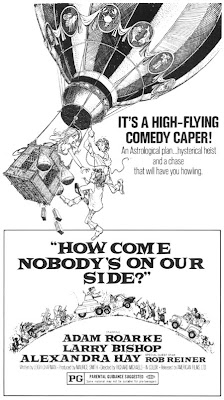
-- the five-man team is en route to Mexico in a rented truck, hauling a crate containing one hot air balloon and desert necessities such as water, gas, and automatic weapons.


Along the way they pick up a rock group called the Imperial Boat Band, and they perform “Freakin’ on the Freeway” for a couple of hippie hitchhikers in the back of the truck as it heads for the border.


The boys find the ton of grass in a shack on the property of one of Mike’s black marketeering buddies, a guy who normally deals in suede goods but was more than happy to sell the bricks of bud to Mike for eight grand.


Unfortunately, the guy also sold the whole ton to an Afro-American biker gang for five grand.

Tom Johnigarn (from THE BAD BUNCH and SASQUA) plays the leader of the gang.

A gang that wants the ton of grass it paid for.


But Mike and the boys aren't about to give it up.

Plotwise, that’s about it for THE BIG SCORE.

Hanson’s filmmaking is noticeably more polished here than it was in THE ZODIAC KILLER, with some strong compositions, a few well constructed tracking shots and - for the most part - pretty good performances. If he had played by the rules and stuck to the basic adventure story he sets up from the start, he might've had a big drive-in hit on his hands. Instead, he blew it by trying to shoehorn elements of JOE and EASY RIDER into the action template and creating something that didn’t have a target audience in 1972, wouldn’t have had one five years earlier and most likely never will have one outside of the few of you who are reading this now, today, and thinking, "Wow, where do I find a copy?!"

The rampant misogyny that gets a free pass in THE ZODIAC KILLER because it falls within the context of a serial killer storyline has no place to hide this time out as women are excluded from the mix entirely, save for a whore who survives the opening shootout, only to have the Federales drag her around by her hair and slap her silly to reveal the whereabouts of the much sought-after Tijuana treasure, the ton of grass.


Otherwise, females are only alluded to in THE BIG SCORE as ex-wives whose alimony demands provide the impetus for the clods to go on their cockamamie caper. As I wrote last year in my review of THE THURSDAY MORNING MURDERS, a low-budget exploitation movie with no women was box-office poison at the drive-ins. Add to that a no-name cast and not one but two lousy titles -- the first unwieldy and spoilerish (A TON OF GRASS GOES TO POT), the second totally generic and forgettable (THE BIG SCORE) -– and this movie was pretty much guaranteed a one-way ticket to oblivion.

But y'know what? The off-kilter aspects of this film that helped sink it almost 40 years ago are the same reasons we've screened it here at the Temple a half dozen times in the past year, and we wouldn't have wanted it any other freakin' way. It's impossible to tell if Hanson smoked too much of the ton during production or if he was totally off his trolley from the start, but the man's a kind of mad movie scientist and you won’t believe some of the crap he tries to get away in this thing, beginning with that stupid appearance by the Imperial Boat Band. I better show you a few more examples, otherwise this review will be over and I'll be back to worrying whether or not there are 15 other Hanson movies as good as this one waiting to be found somewhere, someday.

While Rick, Hal and the Doc pack the bricks into a crate --


-- Mike and Duke take the truck into town to buy a Jeep from another of Mike’s questionable business associates.


Fred is a sleazy pimp who first raises the price for the Jeep…

…then attempts to stiff them on a boat when Mike misleadingly tells him they’re planning to get the pot stateside by water and not by air…

…and finally tries to hook them up with a couple of his girls.

Sensing that Fred is setting them up for some kind of trouble, Mike tells Duke he’ll meet him back at the shack and sends him out the rear exit of the cantina. Mike then strolls out through the front door and is promptly arrested for attempting to steal the unregistered Jeep he just bought from Fred.

Duke returns to the shack and smokes a fat one with Rick, Hal and Dr. Bell until they’re all stoned out of their minds.


We can tell they’re stoned out of their minds because of the spacey dissolve effects and the way the camera slowly rocks back and forth through the whole scene.

Mike, meanwhile, is trying to figure out who he has to pay off to get out of jail (“You gringos,” laughs one of the guards, “All you care about is money!”).

Back at the shack, the camera keeps swinging as the guys bitch about the generation gap --

-- until Rick, the most liberal of the bunch (an actor – go figure), realizes that Mike hasn’t returned yet and might be in trouble.


So he and Duke return to town and break Mike out of jail by securing a piece of telephone pole to the front of the Jeep and driving it through the brick wall of the police station.

Now, if Hanson had used a real Jeep and a normal-sized breakaway wall I wouldn’t have mentioned this sequence at all -- but because he tried to pull it off with a combination of miniatures and forced perspective for what looks like a $1.98, I'm tempted to name an entire wing of the Temple after this unsung poverty row genius.

Also, this setpiece contributes almost nothing to the plot. The Federales are on Fred's payroll, and since Fred's been fed wrong information, they assume the pot's leaving the country by boat and they're never heard from again. My God -- could it be possible Hanson wrote this segment only because he wanted to try it with toys and trick photography?!

Here we go again -- another stunner. On their way to the balloon’s designated launching point, Mike and the guys encounter a wandering band of spaced-out hippies.

“Good afternoon, fellow Americans. My commune and I are weary. Have you any food you can share with us?”

Mike responds by yelling at them -- in German.

Like he's a Panzer general in North Africa all of a sudden.

I'm tellin' ya, folks, it just gets better and better. A couple of minutes later Johnigarn meets up with the same hippies. “Hey man, how long ago did you see the guys in the truck and Jeep go by?”

“As you can see, they show no love for God’s handiwork..."

"...crushing every living plant that lies before them, tearing and ripping these beautiful flowers from this garden..."

"...destroying these defenseless creatures with their nosy, ugly, polluting machines.”

“Well now -- I guess they just figured it beats walkin’.

How long ago?”

“My family and I were just getting into the rays of the sun as they were gently setting over the crust of God’s mountain.”

“Thanks, Moses.”

“My fellow American, my commune and I are weary. Have you any food that you can give us?”

“Well now, isn’t that something? Man, if I had any – which I don’t – I’d keep it. And besides, if I gave you any food I’d be taking away from your dignity.”

“Dignity? Dignity? What is dignity? It is written ‘The meek shall inherit the earth,’ and as Moses said -- ”

“Copout. Copout. This isn’t the States, y’know! Those kids can starve down here! There ain’t no welfare here. Now why the hell don’t you go home and try standing on your own two feet like a man and get a job.”


“Mommy, what’s a job?”

Not long after this exchange the bikers run out of gas.

They're stuck in the desert with no food, no water, and no ton of grass. Johnigarn is about to cut open a cactus for water --

“Hey man, are you crazy? Maybe that’s bad stuff!”
“What do you expect – Orange Julius?!”

-- when from out of nowhere comes a fully-stocked supply truck driven by special guest star...

...DOODLES WEAVER

Food, water, gasoline -– everything but the kitchen sink and a ton of grass, and thankfully no references to cabbage second by a head.

"Cabbage by a head!"

But wait – WAIT – ‘cause it gets even better. Around the campfire that night the guys talk Mike into smoking a joint with them, hoping it’ll get him to loosen up a bit.

Instead, he insults them by claiming that the effects of marijuana -- like hypnotism -- depend on the intelligence of the subject.

“My dear unlearned friends,” he says in between tokes, “it is impossible to hypnotize an extremely intelligent person. This is also true of marijuana.

My superior intellect refuses to let this filthy weed control my mind.”

Hal loses his temper. “You know what you are? You’re a goddamn dictator!”

Mike smiles. “You know? You just might be RIGHT!” and gives Hal a Nazi salute, which becomes a freeze-frame --

-- which leads into the film’s pièce de résistance --


-- a jaw-dropping 7-minute sequence in which Mike and the guys are depicted as members of the Nazi high command.


7 minutes


In a movie that's only 79 minutes long.


At this juncture I think it’s important to mention that at least 4 scenes were cut from THE BIG SCORE, a fact revealed during the “order of appearance” credits at the close of the film.


The excised scenes presumably introduce Doctor Bell, Hal, Rick and Duke at their respective jobs and show them receiving the invitation from Mike to meet for dinner.

It's probable the 4 scenes were cut in 1973 for the Fine Films release as THE BIG SCORE. The new title seems consistent with the rest of the opening credits and the Fine logo is superimposed over the opening shot, so some preparation went into this release.

However, why those scenes were jettisoned, but two others were allowed to make the final cut unaltered --

–- and I am referring to the 10 minute opener that features none of the principal actors and this 7 minute tinted dream sequence in German (with no sub-titles!) --

–- in a movie that now barely clocks in at 79 minutes --

-- is a question for the ages.


Maybe we should ask the "Tijuana treasure."

The evidence suggests its weight was well under a ton by the time THE BIG SCORE reached the screen!

Subscribe to:
Posts (Atom)


