Saturday, November 03, 2012

Updating the IMDb: The Seattle Edition

Temple of Schlock's friend in Seattle, John Black, told us a while back that his hometown had played host to a number of exclusive movie premieres in the early 1970s, but we only recently got around to investigating his claim. Boy, he wasn't kidding! Here are two major finds that we unearthed within minutes of threading the first reel of microfilm through the viewer.

THE PLOT AGAINST HARRY, writer-director Michael Roemer's second narrative indie feature (following the brilliant NOTHING BUT A MAN), opened in one Seattle theater for a week-long "world premiere" on January 27, 1971.

This quirky, b&w, New York-shot ethnic comedy -- filmed two years earlier -- would've attracted more attention and done some business if it had debuted a few blocks south of 14th Street instead of three thousand miles west of the Hudson. According to Seattle Times critic John Hartl in the review below, the film's "only appreciative audience may be Jewish bookies living in the Bronx."

After this not-so-impressive debut, Roemer put THE PLOT AGAINST HARRY on a shelf and forgot about it for 18 years.

In September 1989, THE PLOT AGAINST HARRY was screened during the Toronto and New York Film Festivals. Press coverage at the time detailed the film's disappearing act without ever mentioning its week-long run in Seattle, alluding instead to a "screening" that failed to secure a distribution deal (New Yorker Films finally released the film theatrically in January 1990). Some sources even claimed that THE PLOT AGAINST HARRY had languished for years unfinished. "Roemer actually shot this film, his second feature, in 1969," wrote Pete Travers in Rolling Stone, "but only recently found the money to complete postproduction."


It’s understandable why Roemer would avoid all discussion of the one-week Seattle engagement, since any kind of theatrical release would’ve made the film ineligible for the major festivals. However, we believe that 20+ years is well past the statute of limitations for this sort of thing, so THE PLOT AGAINST HARRY should now be considered a 1971 film, with January 27, 1971 (Seattle, WA) listed on the IMDb as the official release date.


Less than a month after THE PLOT AGAINST HARRY blew in and out of town, Skip Sherwood's spaced-out independent film DIDN'T YOU HEAR? opened in nine Seattle-area theaters on February 24, 1971. Billed as "The first completely electronically scored motion picture" and shot in widescreen Techniscope at the University of Washington and in the San Juan Islands during the summer of 1970, DIDN'T YOU HEAR? is of interest today for its early lead performances by Dennis Christopher, Gary Busey, and MACON COUNTY LINE's Cheryl Waters. A wider release through Futurama International was scheduled for June 1972, but we've found no evidence of additional playdates.

Skip Sherwood Productions renewed the copyright in 1983, which was the date ascribed to the film when it began showing on TV in 1985. A video release through American National Enterprises (A.N.E.) Home Video/Prism Entertainment also occurred in 1985, but the IMDb considers this a 1983 release. The date should be changed to 1971, with February 24, 1971 (Seattle, WA) submitted as the official release date.


Wednesday, October 31, 2012

The Endangered List (Case File #126)


THE LONG NIGHT (1976)
a.k.a. STEELY BROWN

Starring
Dick Anthony Williams (Paul Brown)
Peggy Kirkpatrick (Mae Brown)
W. Geoffrey King (Fred “Steely” Brown)

Directed
by
Woodie King

Screenplay by
Julian Mayfield
and
Woodie King

Based on the novel
by
Julian Mayfield

Produced by
St. Clair Bourne
and
Woodie King

Associate Producer
Ed Pitt

Director of Photography
James Malloy

Edited by
Joe Staton
and
Ed McAllister

Music by
William Daniels
and
Michael Felder

A
Woodie King-St. Clair Bourne
production

Woodie King Associates Films

Released
by
Howard Mahler Films

“In Color and Sepia Tone”

Running time: 85 minutes

(Note: The film was previewed twice with a bogus G rating prior to being submitted to the MPAA and receiving a PG in 1976.)


Above: The source novel by Julian Mayfield, published in 1958.


‘Life in Harlem’

“The Long Night,” an American film directed by Woodie King, Jr. and written by the director in collaboration with Julian Mayfield. You see almost every dramatic development coming from a mile away in this drama about a young boy’s marathon search for his runaway father in Harlem, but as the story follows its familiar path, director King presents a compelling picture of Harlem neighborhood life, by day and by night. There’s a crude flashback structure, unfortunately, as well as a fondness for clichés culled from black plays of the past decade. Dick Anthony Williams makes up for much that is wrong with his intense characterization of a man whose black pride isn’t enough to help him overcome his long years of defeat in a white man’s world. “The Long Night” is being screened Sunday at 6 p.m. and Tuesday at 8:30.
by Frank Rich
New York Post
4/6/1976, p.24


Below: Theatrical trailer for the re-release as STEELY BROWN.


Sunday, October 28, 2012

Movie Ad of the Week: DON'T LEAVE GO MY HAND (1974)


World Premiere - March 13, 1974 - San Antonio, TX

Arthur Roberson's play Don't Leave Go My Hand was first produced in California in 1969, directed by the late, great Vantile Whitfield. Four years later, Roberson himself wrote and directed a stagey, low-budget film adaptation, and this letter from Roberson's son to Ferris State University's Jim Crow Museum of Racist Memorabilia reveals that Burt Ward of TV's BATMAN was originally considered for the lead role! Artisan Releasing Corporation premiered the PG-rated DON'T LEAVE GO MY HAND in San Antonio in March 1974. By November the title had been changed to BLACK HOOKER, sex scenes with body doubles had been added to get an R rating, and the Wheeler Film Company out of Washington D.C. was unveiling this grittier version in Maryland and Virginia ahead of a more extensive rollout beginning in January '75. It was released on video in the 1980s as BLACK MAMA and 1990s as STREET SISTERS, but the original title of the play as well as the movie is nowhere to be found in the IMDb and other references such as the poorly researched FAB Press book Blaxploitation Cinema.


Saturday, October 27, 2012

Clippings: 40 years ago today


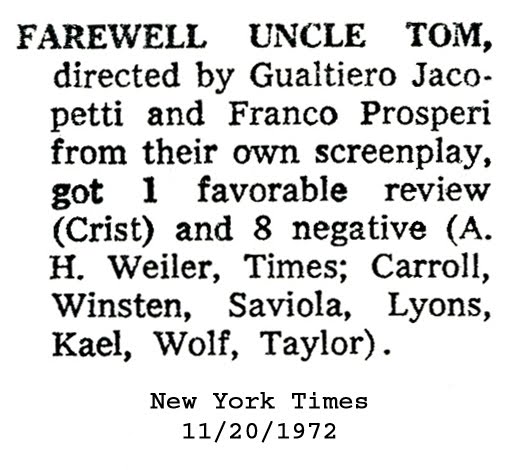
Gualtiero Jacopetti and Franco Prosperi's FAREWELL UNCLE TOM opened in three New York City theaters on October 27, 1972.


It’s Hysteric, Not Historic
by Kathleen Carroll

“Farewell Uncle Tom,” at the Cinerama, RKO 59th St. and 86th St. Twin II, is purportedly an “inquest,” or an on-the-spot investigation of slavery in this country.

This investigation is conducted by those cinematic muckrakers, the creators of “Mondo Cane,” Gualtiero Jacopetti and Franco Prosperi. Posing as visiting journalists of the period, the filmmakers pretend to interview everyone from a slave breeder to Harriet Beecher Stowe. After confiding that she intends to write a book, she tells the “European” journalists: “I think I’ll call it ‘Uncle Tom’s Cabin.’”

Having recreated our shady past in gross, stomach-turning detail, Jacopetti and Prosperi have the conceit to add a musical score that is pure Fellini. They claim that their film is based entirely on historical fact. But don’t be fooled. These two care nothing for historical accuracy.

What interests them is the hysterical fact, some sensational revelation that can startle or arouse.

What is so loathsome about their style of filmmaking is that they have the gall to pretend that their vulgar exposés are done for humanitarian purposes, when the only thing that appears to interest them is inciting an audience. Do yourself a favor: miss this movie.

(Daily News, 10/28/1972, p.2)


Sunday, October 21, 2012

Movie Ad of the Week: SUPERSONIC SUPERGIRLS (1973)


SUPERSONIC SUPERGIRLS, the super unwatchable sequel to the 3-D box-office smash THE STEWARDESSES (1969) and also known as INTERNATIONAL STEWARDESSES, opened in 22 theaters in the New York tri-state area on October 5, 1973. Advertised with a fake R rating, the movie was slapped with a real X rating by the MPAA three weeks later, but that was just the beginning of this movie's strange and confusing history. We thought our review from a few years ago would finally convince the brains at the IMDb that this movie actually exists and isn't a re-release version of THE STEWARDESSES, but no, after years of listing SUPERSONIC SUPERGIRLS/INTERNATIONAL STEWARDESSES as a.k.a.'s for the '69 smash, they've now deleted both sequel titles from the database altogether. As bad as it is, SUPERSONIC SUPERGIRLS is a real movie that was released and re-released under various titles and in different versions, so it should have its own entry. Below is what we know about the movie, collected from 3-D Filmmakers: Conversations with Creators of Stereoscopic Motion Pictures by Ray Zone, 3-D Movies: A History and Filmography of Stereoscopic Cinema by R.M. Hayes, and our own research and viewing of the film. It's enough to start an IMDb entry.

SUPERSONIC SUPERGIRLS (1973)

Written and directed
by
Alf Silliman, Jr.
[Allan Silliphant]

Produced by
Chris J. Condon
and
Allan Silliphant

Executive Producer
Louis K. Sher

CAST
Mary Pat Bonney (Candice)
Phyllis Denicke (Pixie)
Goncha Ondemir (Mira)
Peggy Church (Deeanne)
Corona Faora (Pam)

with
Adrienne Stroud
Delana Bissonette
Sally Stevens
Maurice Reese
Vicky Christy [Victoria Silliphant]
Kathy Francis
Kitty [Kathryn] Holcomb

Filmed in
StereoVision
(Single strip side-by-side .67:1
and optically converted to
over-and-under 1.75:1)

Presented in
3-Depix

Optical Conversion
by
Marks Polarized Corporation

in
Eastman color

RCA Photophone recording

Filmed on location in the U.S.,
Portugal, West Germany,
Italy, Greece, Hong Kong

A
StereoVision International, Inc.
production

Released by
Sherpix, Inc.

Running time: 91 minutes
MPAA rating: X

Release date: October 5, 1973 (New York, NY)

Re-released as
INTERNATIONAL  STEWARDESSES
beginning in May 1974
by Rumson Film Distributors

Also known as
THE STEWARDESSES, PART II
SST
AIRLINE!
THE STEWARDESSES, PART III
JET SET
MR. HOWARD'S CRAZY AIRLINE

Saturday, October 20, 2012

The Endangered List (Case File #125) - FOUND!


WATCH OUT FOR THE BUMMER (1971)

Starring
Daniel Clifford
Michael Greene
Kathy Francis
Siaan Nichols

Written and Directed
by
Michael F. Elliot

Produced by
Daniel Clifford

Released by
Unusual Films International

MPAA rating: X
Edited for re-rating: R

World Premiere - Raleigh, NC - December 1971   
 
Star Here for 'Bummer' Opening

Harold Clifton left his native Raleigh when he was 18. He returned to the Capital City this month as actor-producer Daniel Clifford for the World Premiere of his first major motion picture, “Watch Out for the Bummer.”

And Friday he will be in Wilmington for the opening of “Bummer” at the Colony Theatre, on hand to meet and greet patrons from 6:30 p.m. to 9 p.m.

During a promotion tour of the Port City earlier this week, the ruggedly handsome Clifford left a trail of secretaries swooning in arguments over whether his eyes are green, gray or blue.

Regardless of their color, his eyes sparkle as he discusses “Watch Out for the Bummer.”

“There are so many films these days with terrible endings. You leave the movie, go home and can’t sleep. Our film reverses that syndrome.”

The “our” in “our film” refers to Clifford, who stars in and produced the movie, and writer-director Michael F. Elliot.

“Bummer,” Clifford explains, tells the story of a young writer who is in a negative and unconsciously destructive period of his life.

“He is unable to cope with reality or to relate to other people without trying to use them; he loses his fiancée, his friends.

“Through his interactions with various people, he finally discovers as long as he’s got his health and freedom, he’s got everything.”

Clifford says “Bummer” does not deal with drugs, as the title might imply, since “a bummer can be anything that gets you down on life.

“It’s a film that really turns on the young people, and older people look at it as being a very realistic film.

“And it is an honest film, in that it parallels man’s personal problems with society’s problems.”

To capture the realities of today’s world, Clifford said, Elliot attempted to break every cinematic tradition.

“First, he refused to write the script except as filming was going on, because he said he did not want to lose the determinations of the life force; in other words, write as we live it.”

Also, for the first time in any feature length film, Clifford explained, the camera was hand-held throughout the entire film, “lending the photography an emotionality of its own.”

And, too, Clifford and Elliot formed their own company, Infinite Eight Productions Inc., beginning the quarter-million dollar film on their own without a studio affiliation.

Clifford says neither partner wants a studio affiliation because too many fine films become victims of the “studio syndrome,” being shelved if they don’t meet success in New York or Los Angeles.

In further efforts for realism, “Watch Out for the Bummer” was filmed on locations from Southern California to Northern San Francisco.

Clifford noted, “We tried to capture reality on film. We did not use a sound stage or phony sets, but in the streets and parks of San Francisco and Los Angeles, on a boat in San Francisco Bay going around Alcatraz island, in Topanga Canyon near Los Angeles.

“The reality of this film not only effects the filmgoer with a complete emotional experience, but an enlightening one, and you go home feeling good.”

Clifford is less inclined to discuss his own life. Upon leaving Raleigh as a teenager, he joined the Air Force and served three years in Germany, returning to the Capital City to spend “several years” in the contracting business.

He describes himself as “a shy, introverted kid in high school,” for whom delivering an oral book report in front of the class was “pure, tongue-tied agony.”

However, despite no previous leanings toward the theater, Clifford says one day while knocking around California he noticed the Pasadena Playhouse was accepting students and impulsively decided to try out.

“It was purely an inspiration of the moment, and probably the worst audition to ever happen, but they must have seen something I didn’t because I was accepted.”

Thereafter followed a season of Shakespeare - 55 performances of four plays - and a tour of 30 states with Bishop’s Company production of “St. Joan.”

But, somehow, Clifford still gives the impression of that shy, introverted kid, and readily admits, “I don’t believe I’ll continue as an actor for much more than five years. I really prefer being behind the scenes.”

“The actor is more a tool of the director; he’s told what to do, how to do it; he doesn’t know why and there’s usually no time to explain the directions.

“As a producer or director you can decide what to you’re trying to tell the world, what you really want to say.”

And, Clifford says he wants to stay in films that speak of realism.

“Films in the past have meant escapism, fairy tales. But films can be an important medium in these days when people are being bombarded by information, a tremendous amount of information, form all forms of media.

“Films can show what is happening today; there are changes occurring constantly in today’s world, and if you’re not learning to change, you’re stagnating.”

“This is really the message ‘Bummer’ is trying to get across. The film is trying to say a human being can adapt, he can’t get in such a depressed state that he can’t bounce back, that he can’t get his life in shape.”

Clifford’s plans call for production of another film, “The Road to Jesus,” beginning in February. “In this we hope to investigate the Jesus movement among today’s youth, mostly filming around Asheville.”

But for Clifford’s “today,” Wilmington’s Friday, he and “Watch Out for the Bummer” will be debuting at the Colony Theatre.

One more note for the swooning secretaries: that little two-year-old charmer in the film is Clifford’s real-life son Jimmy. Sorry.

(Star-News - Wilmington, NC - December 16, 1971 - p.6D)


Friday, October 19, 2012

Po-Man talks with artist Mort Künstler!


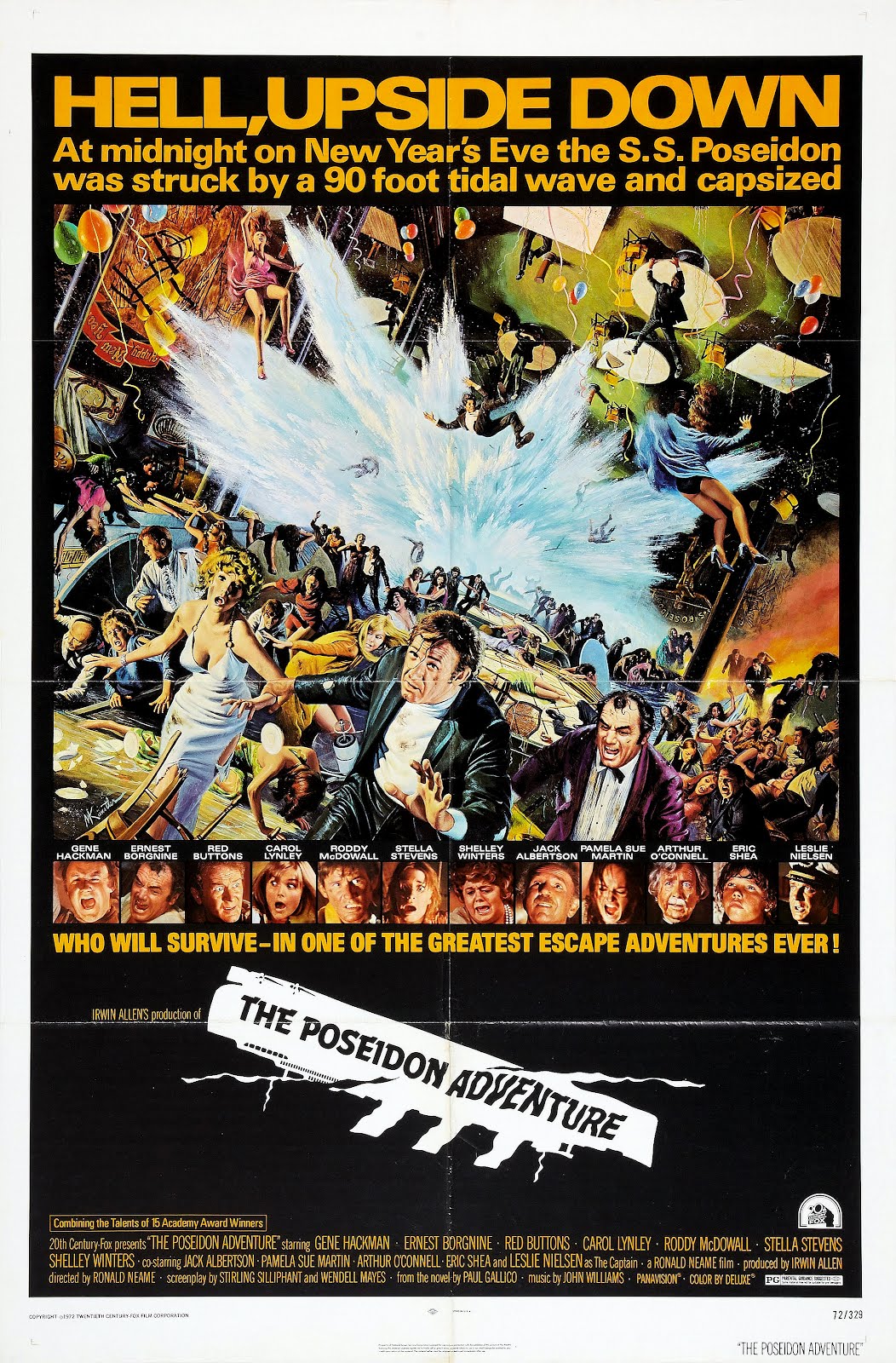
Although he’s known today as America’s premier historical artist, Mort Künstler has painted everything from Classics Illustrated front covers to Mad magazine back covers, with thousands of works in between, during an incredibly prolific career that has spanned over 60 years. During the 1970s he was one of the most prominent artists working in the field of motion picture promotional art, painting the posters for movies ranging from THE POSEIDON ADVENTURE and THE TAKING OF PELHAM 1-2-3 to THE GOLDEN VOYAGE OF SINBAD and THE OMEGA MAN. Earlier this year Mr. Künstler took a break from his very busy schedule to talk with Chris Poggiali about his years designing some of the most exciting movie posters of the 1970s. The full Q&A appears in the latest issue of Cinema Retro (Vol. 8: #24), on sale now. Here are the outtakes from that interview.

Chris Poggiali: You were commissioned to do two different paintings for THE POSEIDON ADVENTURE (1972), which celebrates its 40th anniversary this year. Did you always paint more than one piece for every movie?

Mort Künstler: No, most of the time it was one. In the case of THE TAKING OF PELHAM 1-2-3 (1974), they asked for three different pieces. There was one that was used for the European poster, of the train coming at you with a guy silhouetted in the doorway.


Then there was another one that I don’t know if they ever used, which shows people on the subway car reading and doing what they’re doing, and three guys among them who all look alike with the same glasses, raincoats, the hats… [Laughs] It’s before the subway car gets taken over.

Poggiali: And then there’s the most common one, with the gun in the foreground.


Künstler: Right, the big machine gun coming from the lower left corner.

Poggiali: You did something similar in the art for BREAKHEART PASS (1976).

Künstler: With the foot in the foreground, about to step on [Charles Bronson’s] hands...

Poggiali: …as he’s hanging from the train! With one image, you manage to capture the action, excitement and danger of these movies better than any trailer.


Künstler: I specialized in that sort of stuff and developed a knack for it, so the work came to me. And I enjoyed doing it.

Poggiali: There’s also a wonderful sense of depth and detail in your work. A great example of this is your art for the Moms Mabley comedy AMAZING GRACE (1974).


Künstler: Oh, that was fun! They told me “Exaggerate it, make it crazy! We want [Moms Mabley] to be coming right at you!” That was done for a movie boutique, which was what we’d call an agency that just did movie advertising. I think it was Rosebud.

Poggiali: Rosebud -- as in the sled?

Künstler: Yes, and they had something from CITIZEN KANE in their waiting room -- maybe the director’s chair or the camera that was used? It wasn’t the sled though! AMAZING GRACE was a very different style for me, almost cartoonish. I don’t know if you would’ve recognized that as mine.

Poggiali: But your signature appears on many of your movie posters.


Künstler: Well, the movie people never wanted to have the artist’s name on the poster. They weren’t interested in selling the artist -- they wanted to sell the movie and the names of the actors. If you signed the picture they would almost invariably take it out. So I used to sign a lot of these movie posters in such a way that they never found it! [Laughs] I remember the signature on AMAZING GRACE. I painted it on the car bumper. For THE TAKING OF PELHAM 1-2-3, it’s on a car card -- y’know, the advertisements on the subway? I made one of the car cards my signature.


Poggiali: What about THE POSEIDON ADVENTURE?

Künstler: I think I put it in the splash of the water. Who knows? I don’t remember. I used to have fun hiding the signatures, like it was a game. I assume other artists did the same thing, because a lot of people know who painted these movie posters. One you probably wouldn’t know I did was THE HINDENBURG (1975).


Poggiali: You didn’t sign that one?

Künstler: No, I couldn’t get the painting done in time! They didn’t give me enough time for it to make the poster, but it was used in every ad you ever saw, in black-and-white and in color. The movie poster itself was done slapdash by someone else, I don’t know who.

Poggiali: That’s the opposite of what happened with GO TELL THE SPARTANS (1978).


Künstler: I did the poster for that one.

Poggiali: And somebody else did the artwork for the newspaper ads. Another poster of yours I really like is THREE THE HARD WAY (1974), which features an ensemble painting of Jim Brown, Fred Williamson and Jim Kelly over three smaller paintings depicting each of them in a separate action scenario.


Künstler: That was done for a movie boutique, but a good part of it was my own concept. It was one of the few times where I was called in at the very beginning, so I had input on that one. I said, “It’s called THREE THE HARD WAY, so why don’t we have three separate pictures of the three stars?”

For the full interview, pick up the latest issue of Cinema Retro (Vol. 8: #24), on sale now!


Sunday, October 14, 2012

Movie Ad of the Week: NEGRO ES UN BELLO COLOR (1974)


The tragic interracial love story NEGRO ES UN BELLO COLOR (BLACK IS A BEAUTIFUL COLOR) -- a Mexican production starring Libertad Lamarque, Fernando Allende and Jeanne Bell -- opened in nine New York-area Spanish-language theaters on Wednesday, April 24, 1974.


This was one of the last leading roles for Lamarque, an Argentine actress-singer who was embraced by the Mexican film industry and became famous throughout Latin America after being blacklisted in her home country by Eva Perón. She toplined only two more movies after this one, then made the transition to television, where she continued to work until her death in 2000 at the age of 92.


Lamarque plays Eugenia, a famous actress-singer who is dismayed to find out that her son Mario (Allende) is in love with a black woman, Joyce (Bell), whom he intends to marry.


Allende, a popular Mexican actor who also appeared on American television shows in the 1980s and '90s (including a recurring role on the nighttime soap FLAMINGO ROAD), recently made his directorial debut with the feature film MARÍA (2010), starring his son Adan Allende as Efrain, the role he himself had played 38 years earlier in Tito Davison's filmed adaptation of the Jorge Isaacs novel.


However, what really drew us to this movie was Jeanne Bell, Playboy's Miss September 1969 and the gorgeous star of our favorite Cirio H. Santiago fighting femmes flicks, TNT JACKSON (1974) and THE MUTHERS (1976). Ms. Bell also appeared in POLICEWOMEN, THREE THE HARD WAY, and THE KLANSMAN the same year.


NEGRO ES UN BELLO COLOR is available on DVD, and also turns up on Spanish television stations, but there is no English subtitled or dubbed versions that we know of.


Sunday, October 07, 2012

Movie Ad of the Week: EVEN ANGELS EAT BEANS (1973)


Italian actor Bud Spencer (real name: Carlo Pedersoli) had already appeared in a half dozen films as the beefy sidekick to Terence Hill (Mario Girotti) when the director of their most successful team-ups decided to pair Spencer with Giuliano Gemma for the TRINITY-type roaring '20s gangster comedy ANCHE GLI ANGELI MANGIANO FAGIOLI (1973). 20th Century Fox, perhaps eager to cash in on Avco Embassy's stateside success with the Hill-Spencer films, acquired the U.S. rights and began a theatrical rollout on December 5, 1973 in San Antonio, TX. Spencer didn't return for the sequel, ANCHE GLI ANGELI TIRANO DI DESTRO, also directed by Enzo Barboni under his "E.B. Clucher" pseudonym (misspelled "Clutcher" on the IMDb, which has this as a 1974 release in the U.S.).