Showing posts with label GUEST REVIEWS. Show all posts

Monday, November 03, 2014

Guest Review: TIGER BY THE TAIL (1969)

Il nostro buon amico Tim Ferrante, a 30-year-plus veteran of the world of fandom, returns to the Temple today for another installment of "Guest Reviews." In addition to writing for such publications as Fangoria, Starlog, Gorezone, Comics Scene, and The Splatter Times, Tim created the Westerns...All'Italiana! fanzine in 1983, co-founded The Phantom of the Movies' VideoScope magazine in 1993, and for 10 years owned and edited GameRoom, a magazine aimed at fans and collectors of coin-operated pinball and video games. He was the vice president of the publishing company Imagine, Inc. and also wrote, produced & directed the trailer compilation video DRIVE-IN MADNESS! (1987). Here he is with a review of...


TIGER BY THE TAIL (1969)

Written by Charles A. Wallace
Produced by Francis D. Lyon
Directed by R.G. Springsteen

CAST: Christopher George, Tippi Hedren, Dean Jagger, Charo, Glenda Farrell, Skip Homeier, John Dehner, Alan Hale, Jr., R.G. Armstrong, Lloyd Bochner, Dennis Patrick

Reviewed by Tim Ferrante

R.G. Springsteen’s TIGER BY THE TAIL (hereafter TBTT) provides a warm return-to-childhood experience for those of us who gluttonously ingested ‘60s television programs. Christopher George top-lines its cast of familiar TV faces that’s augmented with fallen big screen beauty Tippi Hedren.


George portrays Steve Michaelis (Mick-AY-lis), a military vet returning to the States after a three year Southeast Asia tour. A stopover dust-up in a Mexico bar creates some bad press that follows him to his home turf of El Paso and the ire of his brother Frank (Dennis Patrick), the prominent shareholder of Ruidoso Downs race track.


Steve’s inauspicious welcome by his testy brother suspiciously coincides with the track's delivery of $1 million by armored truck and an armed robbery that goes exactly as unplanned when brother Frank is killed. It’s an inside job and the perpetrators are gifted with the perfect patsy: Steve Michaelis.


After all, he has the most to gain by Frank’s death...he’s the sole heir to his brother’s controlling interest in Ruidoso Downs! Sheriff Chancey Jones (John Dehner) encourages his prime suspect to assist the official investigation with his own snooping.


But time is of the essence; Frank’s will stipulates that Steve must make a buyout offer to the four other owners within three days otherwise the controlling shares revert back to them. The suspects are many and all possess enough motive to want Frank dead. Steve gradually peels the onion between frame-up attempts, bullets, a dead body here and a punch-up there. The last Act’s surprise reveal pits him and the robbery’s mastermind in a one on one confrontation.


Eddie Cantor once observed that in show business, “Likeability is 90 percent of the battle.” His insight is clearly evident with Christopher George’s spot-on portrayal of self-assured Steve Michaelis and explains why he worked continuously until his death in 1983. George is exceedingly likeable regardless of his character, so when it came to leading man duties for TBTT casting director Kerwin Coughlin knew exactly who he needed. His quick rise to notoriety was well-earned. The handsome George had already appeared in commercials, trod Broadway boards, wowed photographers as a print ad model in the early ‘60s and starred as Sgt. Sam Troy in ABC-TV’s THE RAT PATROL (1966-1968). He appoints his character with charm, strength and a determined will to solve his brother’s murder.


Tippi Hedren portrays Rita Armstrong, Frank Michaelis’ arm candy squeeze who Steve suspects may have something to do with the robbery and murder. She portrays Rita with detached sexuality similar to her characters in two Alfred Hitchcock films, THE BIRDS (1963) and MARNIE (1964). Hedren’s casting is notable; five years earlier she was one of Hollywood’s hottest names with no shortage of directors who wanted to work with her. Hitchcock, who’d signed her to an exclusive contract in 1961, launched the erstwhile unknown into immediate fame. But it was her resistance to Hitchcock’s oppressive control and the rejection of his tender advances that resulted in the portly auteur dousing his plans for Hedren’s long term superstardom. After only two pictures Hitchcock handcuffed her career, damaging it so severely that it would never recover. By 1969 she’d swapped leading men like Sean Connery in MARNIE for Christopher George in TBTT. Ironically (fittingly?) Hitchcock’s post-Hedren years produced only four more films with only one – FRENZY (1972) – exhibiting any notion of the director’s gift for terror and suspense. Hedren's rear view summation of her mentor's punishment? “[Hitchcock] ruined my career, but he didn't ruin my life.”


The film is indeed a treasure for its pleasantly familiar cast, all of whom were seasoned pros used to working in the fast-paced production of weekly episodic television. Alan Hale, Jr. plays race track co-owner Billy Jack Whitehorn. He gives Whitehorn a “Skipper-ish” overlay that’s abandoned when delivering some shady “I know nothing!” lip to Steve Michaelis’ probing. It’s a tangential part, but Hale portrays the worried man effortlessly.
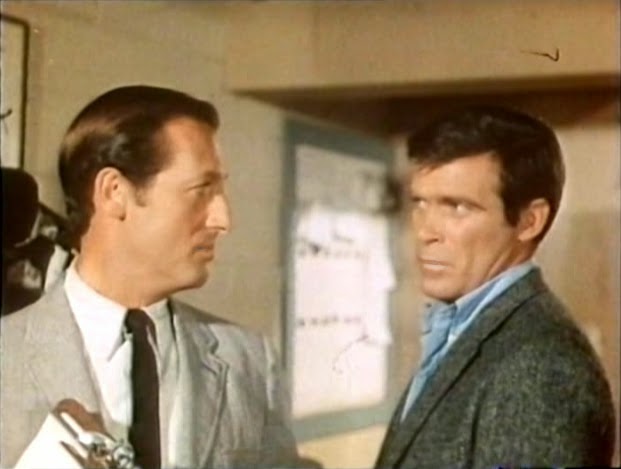

Few actors possess Lloyd Bochner’s ability for playing scheming crooks with such smarmy class. He’s cast as Del Ware, a track co-owner who agreed to the robbery, but never agreed to murder. Steve brings the conflicted nervous wreck to the brink of a near confession early on, but it’s too little info and fate has a decidedly different plan for Del Ware. The Canadian-born Bochner’s wall-to-wall television and movie appearances began in the ‘40s and didn’t show any signs of slowing until the ‘90s when the actor was in his seventies. Amongst a lifetime of fictional characters and voice-overs, the multi-talented performer is never more delightful than when he was himself – on more than one occasion – as a celebrity guest on the early ‘70s syndicated game show, BEAT THE CLOCK. For Bochner it was a bit of a homecoming as the show taped the majority of its seasons in Montreal even though it was an American production. Watching the ever-polished Lloyd Bochner executing crazy stunts in a race against time is a long-lasting visual incongruity!


Another TV notable is John Dehner who portrays Sheriff Chancey Jones with some of his adept western acting style. Jones is a big city cop who came to El Paso for a softer gig as his segue into retirement. He’s a savvy, firm-footed lawman who eventually warms up to Steve, tolerating his heavy-handed approach in finding his brother's murderer and the missing million. Dehner’s background is throat deep in performance genres and artistic pursuits. It would have been impossible not to have heard or seen him during his most productive decades. He worked as a Disney animator (!), he performed on radio, in motion pictures and countless TV shows. His wonderful baritone pipes gave voice to hundreds of cartoon characters and narrations. Whether it was a dull-witted Nazi on HOGAN’S HEROES (1965-1971) or a colorful tale-spinning drunk on BONANZA (1959-1973), John Dehner brought studied professionalism to every part. His appearance in TBTT is one of its shining attributes.


The list of household faces also include Dean Jagger, Charo (in her American film debut), Skip Homeier, Burt Mustin and the great R.G. Armstrong whose supporting role as law officer Ben Holmes is a thorough misuse of this remarkable actor.


TBTT was filmed in Ruidoso Downs, New Mexico (its race track remains fully operational to this day) doubling for El Paso, Texas. Various online sources can’t seem to agree on its release year with 1968, 1969 and 1970 all being cited, but TBTT’s National Screen Service code is 69/322 which indicates the film’s theatrical availability in the last quarter of 1969. It was one of several produced by United Pictures Corporation (UPC) whose primary mission was to make feature motion pictures suitable for network and syndication television. UPC co-founder and TBTT's producer was Francis D. “Pete” Lyon. His film career began in 1923 as a menial studio laborer when the future Academy Award winner – for co-editing BODY AND SOUL (1947) – needed money to pay his $25 per semester college tuition. In his 1993 autobiography, Twists of Fate: An Oscar Winner's International Career (Evanston Publishing, Inc.), he explained UPC's business plan:


“[In 1966] some associates and I started United Pictures Corporation to produce color feature films aimed principally for the growing syndication and network television markets. We produced a program of nine action-adventure pictures with a couple of science fiction shows included. As the guiding forces of the production team, Earle Lyon (no relation), a most knowledgeable filmmaker, functioned efficiently as executive producer. I had directed some WELLS FARGO episodes he produced at Universal and thought he had fit into our program. Edmund Baumgarten, a former Bank of America motion picture loan officer and former president of Regal Pictures, was in charge of business affairs; I was in charge of production. We were fortunate to get a couple of imaginative writers. Arthur C. Pierce and Charles Wallace came up with some interesting scripts and were very cooperative in our small production group. I directed five of the nine pictures we made, and all but the first one, CASTLE OF EVIL (1966), which was distributed independently, was sold to CBS either for network or syndication. We believed that a well-mounted product with recognizable names in the cast, made at a modest price, would return a reasonable profit to the production company from the television markets alone. Other shows we sold to CBS include CYBORG 2087 (1966), DIMENSION 5 (1966), THE DESTRUCTORS (1968), MONEY JUNGLE (1967), THE GIRL WHO KNEW TOO MUCH (1969), PANIC IN THE CITY (1968) and TIGER BY THE TAIL (1969). As an example of our casting, in TIGER BY THE TAIL, we were able to get Christopher George, Tippi Hedren, Dean Jagger, Alan Hale, Jr., Charro, Glenda Farrell, John Dehner and other competent people. I was credited as producer and R.G. “Bud” Springsteen as director, with Earle Lyon as executive producer. When we organized UPC, with financing by Canadian oil interests, it was our plan to do our own distribution. However, the backers later saw an opportunity to spin off some of the costs by accepting a distribution deal (and some financing) from Harold Goldman Associates for a healthy percentage of profits.”


The UPC business model of creating product for starved broadcasters was a pioneering idea at the onset. Reviews of TBTT and its UPC-produced siblings sometimes make mention of their “made-for-TV look” or comparing them to “an expensive made-for-tv movie.” As Lyon indicated, the films were indeed made with a sale to television in mind and a lesser concern for theatrical play dates. In a sense,they were made for TV films but not in the conventional meaning of the term. Nevertheless, it wouldn't be long before the networks assumed full control of programming needs by financing their own “made-for” productions designed to attract specific audiences, age groups and – more importantly – advertisers!

R.G. Springsteen - photo from www.westernclippings.com

According to the IMdB, TBTT was director Springsteen’s last film. He spent a lifetime making B-westerns, episodic television and bottom-billed programmers for Republic Pictures and independent producers. Undeniably a skilled filmmaker, his expertise was founded in budget conscious productions and explains TBTT's visual impact.


It also marked the penultimate film edited by Terry Morse. Like his colleague Francis Lyon, Morse's career stretched back to the silent era. His most notable directing assignment were the sequences filmed for the American version of GODZILLA (1957) featuring Raymond Burr.


Perhaps TBTT – and UPC'S output in general – is best summed up by a quote in Lyon's Twists of Fate bio. It's attributed to yet another budget conscious filmmaker, Edward L. (INVADERS FROM MARS) Alperson, who understood when to stop spending time and money on a project for marginal gain. Lyon worked as an editor on a couple of his films. Upon finishing a complete edit of which Alperson approved, Lyon suggested to his boss that he go back and make a few fixes he felt were needed. The penny-pinching Alperson simply turned to Lyon and said, “Pete, don't die from improvement.”

Wednesday, September 17, 2014

Guest Review: Italian All Night Splatterfest (Phoenixville, 8/30/2014)

Former 'zine editor Tim Mayer is back with another festival review, this time from the Colonial Theatre in Phoenixville, PA, famous for its appearance in THE BLOB (1958). These days Tim runs the blog Safe House -- but if you're too young to remember the five issues of Fear of Darkness that he cranked out in two years (1982-1983) with the help of such contributors as Bill Landis, Jim Morton, Rick Sullivan, Richard Green, Kris Gilpin and Dave Szurek, then you need to read Chris P's interview with Tim in the book Xerox Ferox, pronto! While you wait for your copy to arrive from Headpress, check this out...


Colonial Theatre's
Italian All Night Splatterfest 3
August 30, 2014
Colonial Theatre
Phoenixville, PA

by Tim Mayer

Another year has passed and another Italian Splatterfest at the Colonial Theatre in Phoenixville has come and gone. This was the third one. I attended last year’s but didn’t make the one previous so I can’t compare it. Once again I made it all the way to the end. This time my buddy Bill who attended with me made it to the end as well, but our mutual friend Troy couldn’t be there. But there is next year...

The crowd was much the same as last year. A smattering of local metal heads, punkers, film students and over the hill cinemaniacs (such as myself). Some people did the smart thing and had lounges in the back row so they could relax. Some even brought blankets and pillows. Thank Gawd the theater served coffee in the lobby because I needed a boost between movie four and five.

The Colonial has been doing an outstanding job bringing these odd little feature films to the area. If you’d told me in my Exploited Film Society/Fear of Darkness days that I would someday be able to see quality prints of these obscure films in an art house I’d assumed you’d taken leave of your senses. But a dedicated group of fans have sought out the prints and secured the rights to show them in a real theater. Well almost all the rights: more on that later.


As usual, the show opened with a warm-up from the committee who puts on the First Friday horror and cult movie shows. They mentioned the titles of the films we were about to see and credited the theater for allowing them to be shown. Then they handed out prizes based on the ticket number given on entering the theater. Won a DVD of RATS myself, but gave it to the metal couple sitting next to me. I’ve got enough DVD’s and don’t need any more.

From the announcements it became clear one of the movies they were going to show had a rights issue. Thus, in keeping with their request, I’m not going to mention the name of it. I will say that I’d never heard of the film before, which is always a plus.


After some trailers of other Italian horror movies, the show began. The first movie was THE BEYOND (a.k.a. THE SEVEN DOORS OF DEATH. A cheer went through the crowd as Fulci’s name appeared under the director’s credits. This was your standard blood and guts Italian gore fest with little in the way of plot. Filmed in 1980 in the southern USA by an Italian cast and crew, it was one of the best films to be shown. The print was in very good shape, so I’m assuming they got hold of one of the Grindhouse releasing versions. It was complete, unlike the one I saw in St. Louis over 30 years ago. The plot is about a woman who buys a cursed hotel outside New Orleans. It may possess the entrance to hell. With plenty of gore effects, including a man getting his face eaten by tarantulas, this proved to be a big hit.


After some popcorn and soda, the next film began: CREEPERS (PHENOMENON). The print was in good shape and I’d been eager to see this one on a big screen after seeing it for the first time on video years ago. This was director Dario Argento’s attempt to have the same success he’d had years earlier with SUSPIRIA. A film star’s young daughter finds herself in an exclusive Swiss boarding school where a sinister killer is offing local girls. Is the killer someone she knows? Will the local police detective solve the case? I wish I could say it was worth the wait for the big screen version, but the film just doesn’t hold up that well. It was nice to see a young Jennifer Connelly on the big screen, but the movie’s plot ran in all sorts of directions. And most of the big name 80’s rock bands whose music were featured in the film had only a token amount of songs.


And of course you need a real humdinger like DOCTOR BUTCHER MD to make the festival. Originally filmed as ZOMBIE HOLOCAUST, the movie was released in the U.S. as DOCTOR BUTCHER in 1982 when given a new opening and different score. At the time, some New York City fans got into the act by staging a whole Dr. Butcher road show complete with fake patients and nurses. The film itself is about a SE Asian island where zombies are roaming and cannibals are on the rampage. Naturally it begins in NYC, but shifts to the exotic locales once the plot starts moving. This was by far the worst looking print of the evening as it had faded into a red hue. However, the audience didn’t seem to mind.


Next was the movie we’re not supposed to mention due to the rights issue. I will say that [deleted] was faded red, defiantly shot in Italy, and concerned a murder mystery as opposed to a gore express. I didn’t recognize any of the actors in it, another reason why it never had a big release in the U.S. [deleted] featured a masked killer who went around whacking people while dressed as a Roman Catholic cardinal. I wish I could say more, but we were specifically asked not to mention the title on social media. Shhh!

By now the hour was late and many attendees had left the theater. I managed to stagger to the lobby and buy a coffee which kept me going to the final movie: CANNIBAL HOLOCAUST (U.S. title: MAKE THEM DIE SLOWLY). One of the many “Terror in the Jungle” movies which were lensed by Italian studios in the late 70s, CANNIBAL FEROX is the standard most film fans use for extreme splatter porn. I’d never had the opportunity to watch it, cannibals on the rampage isn’t a theme which attracts my interest. The plot concerned a group of Americans who travel to the jungles of South America to prove that cannibalism doesn’t exist. I am not making that up. Along the way they find out otherwise, but not before dealing with drug dealers on the run and vengeful indigenous people. Surprisingly, it was the best movie of the bunch, with a good group of actors, tight direction and a decent story line. What I didn’t care for, and what is the biggest criticism of the movie, was the casual slaughter of animals during the film. Several times we get to see the local tribes hack up live turtles and gut alligators for dinner. I could have done without either of those scenes. The “hook” ending is just as bad as I’d heard.


About 3:30 AM we all managed to stagger out of the Colonial Theatre and make our way home. I was surprised at how many people made it all the way to the end. As for me, this will be a warm-up to the 24 hour horror festival this October in Philadelphia.

Tuesday, July 29, 2014

Guest Review: Exhumed Films' Forgotten Film Fest (Philadelphia, 7/20/2014)

It's been a looong time since a guest reviewer has visited the Temple, so when we met up with former 'zine publisher Tim Mayer at last week's Forgotten Film Fest and he expressed interest in covering the event for us, we happily accepted his offer! These days Tim runs the blog Safe House -- but if you're too young to remember the five issues of Fear of Darkness that he cranked out in two years (1982-1983) with the help of such contributors as Bill Landis, Jim Morton, Rick Sullivan, Richard Green, Kris Gilpin and Dave Szurek, then you need to read Chris P's interview with Tim in the book Xerox Ferox, pronto! While you wait for your copy to arrive from Headpress or Amazon, check this out...


Exhumed Films'
Forgotten Film Fest
July 20, 2014
International House
Philadelphia, PA

by Tim Mayer

Exhumed Films have been putting on shows in the Philadelphia area for the past 17 years. Their goal has always been to screen the sort of films Chestnut Street grindhouses would play in the glory days of the 1960s and 70s. Utilizing a network of collectors, they’ve been able to present films rarely seen outside their initial releases.


So I was excited to attend Last Sunday’s Forgotten Film Festival at the International House near the University of Pennsylvania. International House is a large residence facility built decades ago for foreign students. It comes equipped with a fully functional theater which can project 35mm film, always a crucial element in seeing obscure feature films. International House is a little easy to mistake for an office building, since it’s located next to the University of Pennsylvania.


As always, parking is the one thing to keep in mind when attending a film showing in Philadelphia. I parked right out in front of International House, thinking that – it being Sunday – there would be no street parking fee. Guess again. Because I was adjacent to the U of P campus, that part of Chestnut Street charges for parking from 8AM to 8PM every day. Always look at the parking signs, because if you don’t, you’ll find a nice invitation from the mayor’s office under your windshield wiper.


By the time I picked up my Fest ticket (and purchased another one for this October’s 24 Hour Horror-thon), the show was about to begin. I made my way through a mass of urban hipsters and cinemaniacs to the auditorium. But first I had a chance to chat with one of the organizers and get a question answered: since these are privately-owned prints being shown, does Exhumed Films ever get flak? Has someone ever called them up and claimed to be the rights holder? Apparently not. I was told in 17 years it’s only been an issue three times. Surprisingly in these days when distant relatives pop up and suddenly demand some studio fork over the cash for DVD rights.


Prior to the showing, the packed house was entertained by Mr. Chris Poggiali of Temple of Schlock, who talked about the interesting facts behind the production and release of these forgotten films.  For example, he mentioned that SKATETOWN USA was rushed into production so it could beat the competing roller disco movie ROLLER BOOGIE into theaters by two months.  He also lectured about the mob which swarmed over the Cherokee Theater in Atlanta where SON OF DRACULA premiered.


After one of the organizers warned the audience to view respectfully, the show began. As always, the day began with some classic trailers dug-up from God Knows Where. Most were forgettable, with the exception one for the 1985 Live Aid show which (literally) featured Bowie and Jagger dancing in the streets (going to be a long time before I can burn that image out of my skull).


The first feature was SKATETOWN USA, one of several movies filmed to cash in on the brief roller disco craze of the late 70’s. I’d like to give a precise description of the plot, but it’s not possible. It had something to do with a gang of skaters called the Westside Rollers showing up at a huge roller rink, called Skatetown USA (of course) where a skate competition is being held. Patrick Swayze played “Ace,” the leader of the gang. His appearance provoked laughter from the audience, although they continued giggling throughout the movie. Let’s see, Scott Baio was in the movie as was Maureen (“Marsha! Marsha! Marsha!”) McCormick. I noted the late comedian Vic Dunlop as a concession stand employee. Dean Martin’s uncle, Leonard Barr, made an appearance as an elderly comic who kept up a running gag while Dorothy Stratten (as "Girl at Snack Bar") demanded her pizza. Billy Barty played Flip Wilson’s father. We got to see Flip in drag. And there were more pink afros, tube socks and suspenders than can be imagined, plus impressive camera work and even more impressive skating. Did I cover everything?


SON OF DRACULA (1974) was next, and I managed to miss the credits when I ran out to move my car to a street where the parking was free on Sunday. Chris had told us during his introduction that the film had been re-released by distributor Jerry Gross under the title YOUNG DRACULA after the success of YOUNG FRANKENSTEIN. I learned later that the YOUNG DRACULA title card that was sloppily cut into the print screened at the fest garnered big laughs.

Let me tell you a story about SON OF DRACULA. Years ago this film played my hometown of Dayton, OH. I’d read about the movie in the entertainment section of the local paper, so I was eager to see it. The Nilsson song “Daybreak” was even on the local AM stations. That damn movie played for all of one week at a downtown hippy art theater and then vanished, never to be seen in any format.

Sunday, I found out why.


God was this movie a dog. What genius thought Harry Nilsson would make a great movie star? The man spent the entire movie walking around in a trance while the other actors tried to carry the plot. It had something to do with Count Downe (Nilsson), the son of Dracula, coming to Britain to be crowned the King of the Netherworld. The only watchable parts were Nilsson performing some live music. It was in the afternoon when this film was shown and I still had to fight sleepiness. Couldn’t someone have pulled Nilsson aside and tried to give him acting lessons? The only reaction the movie got from the audience was applause when Keith Moon appeared as one of Nilsson’s back-up musicians.


I also missed the opening credits to the next movie, Andy Milligan’s BLOOD, because I was out buying dinner. During his introduction, Chris explained that this was originally released as the co-feature to LEGACY OF SATAN, but also played in New York, Cleveland, and parts of Illinois and Florida as BLACK NIGHTMARE IN BLOOD (as the second feature to CHINESE HERCULES), and actually made Variety's Top 50 Grossing Movies chart one week under this title. The print screened ran 69 minutes, more than 10 minutes longer than the overseas video releases.


Seeing a Milligan movie on the big screen from a decent source print is, as his biographer put it, “Like a Bigfoot sighting.” In true Milligan form, BLOOD was about a crazed, bickering family. It was set in the 19th century, but anachronisms abounded. At the beginning Dr. Orlovsky (AKA Talbot) had moved his extended family into a secluded house after being out of the country for years. His wife is a vampire and can only be kept under control from a serum his two assistants get from carnivorous plants (which made a noise that sounds like vinyl squeaking) they keep in the basement. His two assistants have also been injured from working with the plants and are barely getting around. And there was a mentally-challenged housekeeper used as a blood supply to feed the plants. At the beginning the good Dr. was running out of patience with his needy wife. Plus, he soon discovers his scumbag family lawyer has been siphoning off money from Orlovsky’s inheritance.


Milligan had a thing for roses and they’re all over the house in BLOOD. Even the lead actress sports roses in her hair. There’s also a hilarious confrontation between Dr. Orlovsky and the lawyer, which makes a lot of sense when you realize Milligan’s chief financial backer was a member of the legal profession. Talky as always, BLOOD lets you know Milligan had a theatrical background. Definitely a real treat!


The second to last movie, MURDER ON THE EMERALD SEAS (a.k.a. THE GREAT MASQUERADE and THE AC/DC CAPER), was in the best shape of all the prints. As it was a shaggy dog joke incarnate, I’m guessing the movie hadn’t passed too many times in front of a projection lamp. A 1973 movie by Alan Ormsby, who gave us CHILDREN SHOULDN’T PLAY WITH DEAD THINGS, SEAS was a comedic mystery about a police detective who goes undercover as a woman to find a serial killer on board a cruise liner (“The Emerald Seas”). Henny Youngman has a 30 second cameo in it, so the film has at least that much humor. But the rest of it consisted of jokes that don’t work today, if they ever did, such as a dwarf telling a tall model he can’t loan her any money this week because “I’m a little short,” or this zinger from an undercover cop: “I should have joined the sanitation department. My brother did and he cleaned up.”


Finally we came to the star of the show, a movie so obscure that it had not been seen in 40+ years: THE SATANIST. This turned out to be a black and white adult film from 1968, arguably the last year anyone was filming feature films in B&W. What I had hoped would be a forgotten horror movie turned out to be one long exercise in watching women with fake eyebrows undress. It began with a brief introduction by a writer in an insane asylum. He wanted to tell the audience a story about what happened to send him there. Next, it moved to him and his wife (in a tight dress) at a motel. And it didn’t go much of anywhere after that point. Since the filmmaker was trying to avoid prosecution by the local censorship boards (this being in the dark days of the 60’s), nothing was shown in front below the waist, of either sex. At one point I thought the movie might go all Kenneth Anger when a semi-nude young woman began casting a magic circle to the sound of sitar music, but this proved to be a ruse. Even the audience began fidgeting in their seats five minutes into the movie. The frequent close-ups of the actors’ ecstatic faces did provoke laughter from the crowd. It appeared to have been filmed without sound.


Most of the attendees enjoyed themselves. On the street it was easy to spot anyone who was there for the festival, because they tended to be wearing David Lynch T-shirts and discussing Argento films – not the sort of conversation you normally hear, even in the vicinity of the university. At one point I noted a couple filming their own “At the Movies” style show with a camcorder. Nor was it unusual to see people in the audience writing down notes as the movies were playing.


Once again, Exhumed Films gave cineastes a chance to travel back in time to the days of sticky floors and stale popcorn, a time where the movie you were going to see could be a retitled version of what you’d just seen last week, or something so fascinating it would change your life. I’m eagerly awaiting the 24 Hour Horror-thon this October.

Monday, January 14, 2013

Guest Review: DARK AUGUST (1976)

To properly introduce Stephen Bissette, our latest guest reviewer, I'd have to write an essay five times longer than the review itself! Mr. Bissette's artwork first caught my attention in the pages of Bananas magazine in the late '70s, but it was the awesome graphic novel adaptation of 1941 that burned his name into my mind forever. Years later, I was thrilled to see my writing appear alongside his in the pages of Fangoria, European 'Trash' Cinema and Wet Paint. Myriad comic book sites, message boards and Wikipedia can tell you the rest, but I highly recommend Steve's excellent blog and fully stocked online store as your next stops. Without further ado, here's Steve with a review of DARK AUGUST! -- Chris P.

DARK AUGUST (1976)
Director: Martin Goldman

A flatlander’s nightmare: brooding, burly New Yorker (J.J. Barry) moves to Vermont, where his accidental hit-and-run killing of a little girl (Karen Lewis) leaves him perpetually looking over his shoulder, fearing the backwoods hoodoo retribution of the child’s grandfather (William Robertson).

Compelling but none too scary, in part due to Barry’s unlikable lead. Still, it’s competently made, mounts some effective suspense, and fascinates with its manifest dread of the very land and people its brutish urban protagonist aches to live among. Stowe, Vermont locals and/or vacationers will want to seek this out for the snapshot of the village in its mid-1970s prime; one sustained confrontation between Barry and Robertson is staged downtown by the fire station, affording a lingering view and plenty of townie talent and extras.

Co-starring Academy Award-winner Kim Hunter (for A STREETCAR NAMED DESIRE, 1951), who is a standout as the rural psychic Barry consults seeking relief; co-scripted by Goldman and lead actress Carole Shelyne, and reportedly filmed in 1975 under the title THE HANT. This PG-rated thriller tasted fleeting theatrical distribution in the US (from Howard Mahler Films, Inc.) and Mexico before its surprisingly wide video release (from Lightning Video in North America and at least two labels in the UK, and other overseas videocassette outfits). Note: Though it didn’t make it into the film version (SILVER BULLET, 1985), Stowe VT is where the young hero of Stephen King’s The Cycle of the Werewolf (1984) was sent to spend the rest of his summer with relatives – after having survived the events of King’s novella.
©2012 Stephen R. Bissette


Saturday, December 31, 2011

Guest Book Review: Jason Zinoman's SHOCK VALUE

Our latest guest review is written by longtime friend and Temple of Schlock researcher Jon Putnam, who many of you may remember for his wonderful liner notes in the Anchor Bay DVD of THE HILLS HAVE EYES. Here is Jon's take on the critically lauded film book...


If you could interview George Romero, Wes Craven, William Friedkin, and just about every other living legend of 1970s movie horror, what would you ask them?  A journalist named Jason Zinoman, who first covered this subject matter for a story in Vanity Fair, found himself in that enviable position, and the result is a book called Shock Value: How a Few Eccentric Outsiders Gave Us Nightmares, Conquered Hollywood, and Invented Modern Horror.

So much has already been written about this era that Mr. Zinoman's real challenge was to come up with new and interesting material. The good news? He is more than up to the task. Where he falls down -- not just falls, but crashes and burns -- is that his book is filled with mistakes. Dates are wrong, citations are incorrect, plot points are sometimes astoundingly off ... perfection is one thing, but Shock Value contains so many howlers that when the author at one point accuses the original HALLOWEEN of being "riddled with errors, big and small," it's hard not to cringe.

Shock Value's focus is the first eleven years of "New Horror" that Mr. Zinoman claims began in 1968 with ROSEMARY'S BABY. "Old Horror" was cobwebs and castles and Vincent Price in a cape. "New Horror" relocated the menace to everyday settings with ambitious young directors at the helm; the author observes that pre-1968 movie horror was the province of actors like Price, while the directors "were largely unknown and considered easily replaceable." The original director of ROSEMARY'S BABY was "Old Horror" vet William Castle, known more for his elaborate gimmicks than for the quality of his films. However, the studio's decision to go with the younger, hipper Roman Polanski -- relegating Castle to producer -- not only changed the direction of movie horror, but also symbolized "a passing of the torch from the Old Horror to the New."

In addition to Polanski, Romero, Craven and Friedkin, Mr. Zinoman identifies John Carpenter, Dan O'Bannon, Tobe Hooper and Brian De Palma as the most important of the "New Horror" filmmakers. One of the book's tenets is that these men paid homage to their forefathers (particularly Alfred Hitchcock), while at the same time rebelling against them, most significantly by refusing to provide easy answers. Therefore, while PSYCHO concluded with a lengthy explanation of Anthony Perkins' madness, the new directors opted instead for "ambiguity and confusion," finding them to be "scarier than certainty." Insisting that Hitchcock's influence is overrated, Mr. Zinoman points instead to H.P. Lovecraft and to live theater, particularly the plays of Harold Pinter ("no playwright had a greater influence on horror") and Samuel Beckett (when making HALLOWEEN, John Carpenter was "[i]nfluenced by the terror of Beckett" and "wanted an empty space at the heart of the movie, where the answers usually are").

Mr. Zinoman has a gift for digging up interesting background on familiar material, including a fascinating chapter on how THE TEXAS CHAIN SAW MASSACRE was bankrolled ("the tale began the same way that the movie ended: with an obsessed man chasing a beautiful woman"). He also calls attention to movies that haven't necessarily gotten their due, including Peter Bogdanovich's 1968 TARGETS, whose "chillingly matter-of-fact style ... anticipated the future of the genre in some ways even more than ROSEMARY'S BABY and NIGHT OF THE LIVING DEAD."

If for no other reason, the book is indispensable for documenting FOSTER'S RELEASE, a 1971 student feature directed by John Carpenter's film school classmate Terence Winkless. The story of a babysitter terrorized by threatening phone calls (coming from inside the house!), FOSTER'S RELEASE was years ahead of BLACK CHRISTMAS, WHEN A STRANGER CALLS, and of course HALLOWEEN, about which Mr. Winkless is quoted as saying, without rancor, "John took it from me no question." Although he seems congenial and easygoing in interviews and DVD audio commentaries, Carpenter comes across here as something of a ruthless jerk who "had been sponging up ideas throughout the decade."

The author bends over backward to paint these "New Horror" filmmakers as misunderstood loners -- the "eccentric outsiders" of the title -- but by and large they seem here like pretty average guys who happen to have talent and leadership ability. The book's most memorable passages are those that probe into their personal histories, yielding some surprisingly intimate and touching results. This might be the first time that Brian De Palma (in a chapter called "He Likes To Watch") has opened up publicly about his troubled family life and its link to the voyeurism theme in his movies. Equally affecting is the portrait of Dan O'Bannon and his father Thomas, a Missouri "hillbilly" whose affection for his only child was preserved in a handwritten journal called "The Book of Daniel."

Dan O'Bannon never hit the heights of his Shock Value colleagues, and his journey seems to have been the roughest. Seething with bitterness toward his former friend and collaborator John Carpenter (who O'Bannon once described as "somewhere below Wes Craven"), and resentful of the success he never quite achieved, O'Bannon was tormented by the Crohn's disease that would claim his life in 2009 -- although, ironically, the stomach pain from that ailment apparently inspired ALIEN's infamous chest-bursting scene.

What undermines Shock Value is its staggering over-abundance of bad information. How did this happen? We are informed that Russell Streiner "played a policeman" in the original NIGHT OF THE LIVING DEAD; that "Bernard Herrmann's shrieking violins from PSYCHO" are played just before the closing credits in CARRIE; that in THE HILLS HAVE EYES, "Craven borrowed a plot device from ROSEMARY'S BABY (the trick of a phone call to the protagonist that looks reassuring but is actually a fake)." A longer list appears at the end of this review.

For some reason, Mr. Zinoman is at his shakiest when discussing LAST HOUSE ON THE LEFT. Where on earth did he come up with the idea that one character "is slashed to death by an electric boat fan"? Or that the lead killer Krug carves the word "Love" onto a victim's chest? Or that the villains "spit at" their victims?

It also seems like a stretch to argue that LAST HOUSE's "dramatic center was an excruciating rape scene" where the attackers "take turns raping one girl" and "make her friend watch." Presumably the author is referring to the early scene in the apartment, when the girls Mari and Phyllis are first taken captive. Phyllis is raped while the camera lingers on Mari's face. But excruciating? This part of the movie is relatively tame compared with the much rougher and more graphic scenes to follow, including the "piss your pants" sequence in the woods and Mari's mutilation/rape by Krug.

Mr. Zinoman further argues that LAST HOUSE takes place in "a godless world" that "includes no struggle with faith." Actually, Mari and her parents are established as Christians -- Mrs. Collingwood mentions God during the opening sequence, and Mari prays aloud moments before her death. The Collingwoods also display a Bible in their living room, at which Krug pokes fun. Characters in Wes Craven's movies are often people of faith, although it seldom serves to protect them from harm.

In the end, the many inaccuracies don't prevent Shock Value from being a worthwhile book. It should make for interesting reading for newcomers and diehard fans of the genre alike: it's a very good introduction to 1970s horror; and for skeptical fans who think they already know everything, there are some pleasant surprises.

**(Following is a list, arranged by chapter, both of outright errors and also what might be errors)**

---INTRODUCTION---

In LAST HOUSE ON THE LEFT, "Krug carved the word 'Love'" onto his victim's chest (p. 2). Two paragraphs later on the same page, the author writes that Krug carved "his initials."  He carves his first name.

The author quotes the tagline for the LAST HOUSE ON THE LEFT ad campaign as "Just keep telling yourself: It's Only a Movie. It's Only a Movie."
The tagline is "To avoid fainting keep repeating, It's Only a Movie ..."

---CHAPTER ONE ("The Devil's Advocate")---

The author writes that William Castle read the galleys for the novel Rosemary's Baby and that one day later his wife read "the script" (p. 12).
She would have read the galleys, since the novel hadn't even been published yet.

---CHAPTER TWO ("The Problem with Psycho")---

"Directors of the horror movies of the late sixties and seventies wanted more ... rock music" in their movies, among other things (pp. 30-31).
None of the directors profiled here relied on rock music in their films.

The author maintains that Alfred Hitchcock "scoffed at a screening of De Palma's DRESSED TO KILL," and quotes John Landis as saying that Hitchcock "'was personally insulted because in the ads, all the critics said that the movie was Hitchcockian'" (p. 31).
Hitchcock died in April 1980 and DRESSED TO KILL was not released until July, three months later. While it's possible that Hitchcock could have seen an early preview of the movie, it doesn't seem very likely, as he was (according to his biographers) in failing health in the months before his death. However, assuming that he did see a preview, there would have been no ads or critical commentary at such an early date.

Herschell Gordon Lewis' TWO THOUSAND MANIACS! "showed the nipples of a woman cut off, milk dribbling out of the holes in her breasts" (p.34).
This scene was in Lewis' THE GORE-GORE GIRLS.

NIGHT OF THE LIVING DEAD "opened ... to admiring reviews in the summer of 1968" (p. 37). On page 47, the author again cites NOTLD as one "of the major horror movies of the summer of 1968."
First, NOTLD's world premiere was in the fall (10-1-68 in Pittsburgh). Second, was it considered a major release? And did it receive any admiring reviews at that time? Variety panned it in their 10-16-68 issue, and the New York Times followed suit when it opened there in December. The movie didn't open in Los Angeles until January 1969, but it did receive a positive review from Los Angeles Times critic Kevin Thomas. (Mr. Zinoman cites the French journal Cahiers du Cinema as having praised the movie, but that wasn't until 1970.)

---CHAPTER FOUR ("Assaulting the Audience")---

All of the comments below are about LAST HOUSE ON THE LEFT:

The movie's "dramatic center was an excruciating rape scene" (p. 74). See discussion in review above.

The killers "abduct two middle-class girls in the woods" and "spit at them," among other things (p. 75).
The girls are abducted in the city and later taken to the woods. Although Krug drools on Mari while raping her, the only person who actually gets "spit at" is one of the killers (Weasel) by a victim (Phyllis).

Wes Craven "claims the graphic murders were a response to the media's delicate treatment of the Vietnam War" (p. 79).
Craven has stated the opposite -- that the media's explicit TV coverage brought the raw horror of war and bloodshed into people's living rooms for the first time, and therefore the public was no longer able to accept conventionally tidy movie deaths.

The movie takes place in "a godless world" that "includes no struggle with faith" (p. 79).
See discussion in review above.

"Junior desperately wants his [father Krug's] attention" (p. 79).
Is this really true? While resentful of his father, Junior never seems to be craving his attention.

The author refers to Mr. and Mrs. Collingwood as "the parents of the victims" (p. 79) instead of the parents of *one of* the victims.

The Collingwoods "do not do the civilized thing and call the police" once they have identified their daughter's killers (p. 80).
They are unable to call the police because the phone is dead.

In the revenge sequence, one "character is slashed to death by an electric boat fan" (p. 80).
Is the author confusing this with the ending of the original I SPIT ON YOUR GRAVE, where one of the rapists is killed with a speedboat's propellers?

The castration scene is "[o]ne of the most humiliating scenes" in the movie (p. 80).
I guess it's a matter of opinion, but considering the many more disturbing moments in the movie, calling this scene "humiliating" seems like a stretch. It inspires more groans or laughs than anything else.

When LAST HOUSE first "started getting picked up by theaters," it "mov[ed] from city to city in short runs" (p. 81).
Actually, it had lengthy runs in several cities. It also opened in multiple cities at once, such as Chicago, Cleveland, Milwaukee and Washington, DC (in October 1972). This raises doubt about the author's assertion that "[t]here were very few prints" of the movie (p. 82).

Roger Ebert's column about watching NIGHT OF THE LIVING DEAD at a matinee filled with children was "a story for Reader's Digest in 1970" (p. 83).
The story was published in the Chicago Sun-Times in January 1969, and was reprinted in June 1969 in Reader's Digest.

"As a kid, George Romero stayed up nights in New York curled up in bed reading old copies" of Famous Monsters of Filmland (p. 84).
Romero was born in 1940 and Famous Monsters was not published until 1958.

---CHAPTER FIVE ("Shock or Awe")---

THE OMEN "returned to the theme of a woman who gives birth to the Antichrist" (pp. 103-104).
The woman (Lee Remick) gives birth to a normal child who is secretly replaced by the Antichrist, whose mother was "a jackal."

---CHAPTER SEVEN ("The Dance of Death")---

In THE TEXAS CHAIN SAW MASSACRE, "Sally Hardesty" is "the pretty blonde" (p. 127).
The other girl (Pam) is blond too.

"Before heading into the house for the first kill by Leatherface, the roaming camera sets up behind a blond girl on a swing" (p. 141).
This is the second kill. The first kill is the blond girl's boyfriend, while she waits outside on the swing. Eventually she gets up to look for him, which is when the camera follows her into the house.

"Prominent critics," including Roger Ebert, did not start taking THE TEXAS CHAIN SAW MASSACRE seriously until two years after its original release, and the author quotes Ebert's Chicago Sun-Times review (pp. 147-148).
Ebert's review appeared at the time of the movie's original release in October 1974.

---CHAPTER EIGHT ("He Likes to Watch")---

**The author quotes Brian De Palma's description of an experimental theater performance where a man threw coins at the stage and hit an actress, who responded violently. "'She went after her,'" the author writes, instead of "She went after him" (p. 160).

"As CARRIE returns to the bird's-eye view of the opening shot right before the credits, Bernard Herrmann's shrieking violins from PSYCHO can be heard" (p.168).
The shrieking violins appear elsewhere in CARRIE, but not in the final scene.

Nancy Allen in CARRIE "started working on the scene with P.J. Soles on top of a ladder" (p. 170).
Nancy Allen and P.J. Soles are on the floor in this scene; two other actresses (Amy Irving and Noelle North) are on top of the ladder.

---CHAPTER NINE ("The Thing In-Between")---

THE HILLS HAVE EYES "places a lost family in the middle of the desert, where they are abducted by a mutant gang of maniacs" (p. 176).
Only one person (an infant) is abducted.

In THE HILLS HAVE EYES, "Craven borrowed a plot device from ROSEMARY'S BABY (the trick of a phone call to the protagonist that looks reassuring but is actually a fake" (p. 177).
There is no "fake" phone call to the protagonist in ROSEMARY'S BABY.

At the end of HALLOWEEN, "when Laurie asks the doctor about who the killer was ... [h]e simply tells her, 'It's the bogeyman'" (p. 182).
He tells her, "As a matter of fact, it was."

**The author writes that the audience never sees the killer in BLACK CHRISTMAS "except for one shot of his eyes peeking out of the crack in the door to the attic" (p. 186).
The audience glimpses the killer in Margot Kidder's death scene. Also, the eye (just one) mentioned above is peeking out of the crack in a bedroom door, not the attic door. (There is no door to the attic: it is reached via a ladder and trapdoor.)

HALLOWEEN was released in 1978 "with a carefully planned rollout starting in Kansas City, far away from the media on the coasts. It moved on to Chicago ..." (p. 188).
Actually, Los Angeles and New York were among the first (if not the first) cities where the movie opened in October 1978. It did not reach Chicago until mid-November.

One of the "early reviews" of HALLOWEEN came from Roger Ebert, who "singled it out on his popular television show AT THE MOVIES" (p. 188).
At that time, the show was called SNEAK PREVIEWS and was co-hosted by Ebert and Gene Siskel. When HALLOWEEN opened in Chicago in November 1978, Siskel and Ebert reviewed (and praised) it on their show. However, the author here cites a 1980 SNEAK PREVIEWS episode on the "slasher movie" trend, not the 1978 episode where HALLOWEEN was originally reviewed. (Ebert and Siskel also gave HALLOWEEN very favorable print reviews in their respective newspapers.)

---CHAPTER TEN ("Stomaching It")---

"Carpenter went on to make his own repulsive movie in his 1981 remake of THE THING FROM ANOTHER WORLD" (p. 207).
The remake (THE THING) was released in 1982.

---CHAPTER ELEVEN ("The Fear Sickness")---

**The author mentions DARK STAR as "more influential than great" (p. 214). Can DARK STAR be considered influential?

---EPILOGUE---

Russell Streiner "played a policeman" in NIGHT OF THE LIVING DEAD (p. 232).
He played Johnny, the first victim in the opening cemetery scene!

---NOTES---

Roger Ebert's article "Just Another Horror Movie--Or Is It?" originally appeared in the Chicago Sun-Times in January 1969. However, it is incorrectly cited twice as a Reader's Digest article, and with two different dates: June 1969 (in the Notes for Chapter 4) and June 1968 (in the Notes for Chapter 5).

Roger Ebert's Chicago Sun-Times reviews of MACBETH, THE TEXAS CHAIN SAW MASSACRE and JAWS are each cited incorrectly, with January 1 given as the date that each review initially appeared. The actual publication dates are: MACBETH (4/3/72), THE TEXAS CHAIN SAW MASSACRE (10/30/74) and JAWS (6/20/75).

Review & research by Jon Putnam

Saturday, December 03, 2011

Guest Review: DEAD MEN DON'T DIE (1991)

Today's guest reviewer is Michael Gingold, the managing editor of Fangoria since 1990, titular star of THE SUCKLING (1990) and the screenwriter of LEECHES (2003) and SHADOW: DEAD RIOT (2006). We've been friends with Mike for nearly 25 years, going back to the days when he was cranking out his fanzine Scareaphanalia while attending NYU and we were pasting together issues of TOS during study halls and lunch hours at Henninger High. And speaking of "high," you'll wonder what was being smoked, snorted and/or shot up when Elliott Gould's agent decided a third collaboration with the writer of S*P*Y*S and WHIFFS would be a good career move for his client. Heeeeeere's Mikey with his old-school 'zine review of...

DEAD MEN DON'T DIE

It must have been someone’s idea of a gag to open DEAD MEN DON’T DIE in New York on the same day as FREDDIE’S DEAD. Then again, the title might be construed as a jest about the career of Elliott Gould, who stars in the film. In either case, the joke is funnier than anything writer/director Malcolm Marmorstein comes up with in the film itself. A combination of brain-dead horror comedy and toothless satire about TV news, it’s a riot of running gags that weren’t funny the first time, pregnant pauses for laughs that never come, and more mugging than the last couple of DEATH WISH movies. Academy releases it on video next month, but even the small screen seems way too large to house this pitiful offering.

Gould plays Barry Baron, a broadcast newscaster with a big ego. He thinks he’s run across the scoop of the year when he discovers drug dealings going on in the very building housing the station he works for; unfortunately for him, the thugs murder him before he can break the story. Unfortunately for us, he’s brought back to life by the studio’s voodoo-practicing cleaning woman, Chafuka (Mabel King in a cringingly demeaning role), who sets herself up as his manager and gets him back on the air. He’s looking pretty green and stiff now, but the show goes on anyway. And oh, the hilarity that ensues! Since he can’t read for himself, Chafuka hides backstage and dictates into a voodoo doll, and he echoes what she says, but as a result, he now announces the headlines in a Caribbean accent! And when one of the sheets falls from her grasp, he winds up saying, “De paper done fall to de floor” on the air! And since she reads everything on the page, he winds up saying everything that his pretty co-anchor Dulcie (Melissa Anderson) is supposed to say too! Stop, you’re killing me!

There’s more to the story, most of it having to do with the thugs being startled by Barry’s reappearance, their own deaths and subsequent resurrections at Chafuka’s hands, and an inept young detective who tries to solve the case and win Dulcie’s love at the same time. None of it is the least bit surprising, and Marmorstein brings a complete lack of pacing and timing to the material. No doubt a lot of money went into hiring Gould for this project, because the look is as low as low-budget gets. The entire thing is set in one night and day, almost entirely in one studio-and-office location; the action finally moves outside for a climactic chase that does provide a little zip, but the humor is just as strained here as in the rest of the movie. And whatever Gould was paid, it was too much; his performance is embarrassing, a catalog of bug-eyed stares and flailing arms. The rest of the cast understandably looks bored, with the exception of King, who brings more energy than a script deserves that forces her to say things like, “You be a zombie now, and I be your master!” The real tragedy here is that this tripe was released in the New York area by JGM Enterprises, who also own the rights to distribute Full Moon pictures to theaters. Would someone from the company please explain why DEAD MEN DON’T DIE was accorded a multiscreen break while Stuart Gordon’s PIT AND THE PENDULUM barely saw the light of a projector?

(Originally published in Scareaphanalia #105, September 1991)

Wednesday, November 23, 2011

Guest Review: THE BOY WHO CRIED WEREWOLF (1973)

Today's guest reviewer is Tim Ferrante, a 30-year-plus veteran of the world of fandom. In addition to writing for such publications as Fangoria, Starlog, Gorezone, Comics Scene, and The Splatter Times, he created the Westerns...All'Italiana! fanzine in 1983, co-founded The Phantom of the Movies' VideoScope magazine in 1993, and for 10 years owned and edited GameRoom, a magazine aimed at fans and collectors of coin-operated pinball and video games. He was the vice president of the publishing company Imagine, Inc. and also wrote, produced & directed the trailer compilation video DRIVE-IN MADNESS! (1987). Here he is with a new review of...

THE BOY WHO CRIED WEREWOLF (1973)

Nathan Juran’s furry monster movie was released in 1973 by Universal Pictures as the bottom half of a double-bill with Bernard L. Kowalski’s scaly monster movie, “SSSSSSS”. The company treated both as little more than booking fodder, but for those in the know Juran’s film was the one with a special attribute. It was the third (and final) genre pairing of the director with Kerwin Mathews as his leading man. The duos’ earlier works, THE 7th VOYAGE OF SINBAD (1958) and JACK THE GIANT KILLER (1962), are stop-motion animation extravaganzas and rank amongst the most cherished by fans. While not nearly as demanding, THE BOY WHO CRIED WEREWOLF (hereafter TBWCW) provides sufficient dramatic interest for adults even though the filmmaker’s broader approach is slanted toward a younger demographic. It is, after all, a fairy tale. And like any good fairy tale it meddles with childhood worries and fears which, in this case, bundles parental separation and authority distrust with one’s father becoming a werewolf! It’s about as nightmarish a situation as any youngster could imagine.

The movie wastes no time delivering a tone-setting opening sequence by introducing a werewolf (stunt coordinator Paul Baxley) within seconds of the Universal Pictures logo. The camera pans, zooms and finds something stirring amongst the brush and we catch a glimpse. The main title pops on the screen and a moment later we see a werewolf under a bright full moon, howling in the night! Tom Burman’s unique design of streaked long-hair and canine snout give the creature a fluffy and damn near friendly look. Not especially scary, but certainly something with which to reckon. Ted Stovall’s music is such a critical ingredient here, punctuating everything from the film’s logo to camera zooms to the magnificent reveal of the werewolf. It’s a grand and exhilarating sequence that gives way to more titles, exceptionally scored music, a prowling werewolf and our lead characters’ arrival. TBWCW is Stovall’s only film credit. He is a gifted composer and provided Juran’s film with an extraordinary score and sound. He’s well known within the music industry for his arranging, songwriting, conducting and instrument playing talents. It’s a pity his film music résumé begins and ends with one title.

It’s at his dad’s mountainside home where young Richie Bridgeston, portrayed by Scott Sealey in one of his two documented acting roles, is attacked by a werewolf. Robert (Kerwin Mathews) comes to his son’s rescue and is bitten during the fray, the elder now destined for a hairy future. Investigating the attack is the region’s straightforward sheriff who – in a bit of inspired casting – is played by character actor Robert J. Wilke, a familiar face that was tantamount with western bad guy roles. Richie pleads with the sheriff; he knows what he saw. It was a werewolf! Dad, though, says it was too dark and confusing to be sure about anything, especially when the creature was dispatched by a fall onto a fence post and quickly regressed to human form.

It’s here where we get a sense of Mathews’ reserved acting style. Never considered a thespian heavyweight, there are certain roles for which the actor is perfectly suited. This is a fanciful story with selected characters providing mild comic relief, but Mathews’ character is traditional and compassionate. The horror of a fanged monster within is intensified when embodied in such a mild and caring man. In werewolf makeup Mathews is downright regal! In scenes stalking Richie he’s lightly campy and rather ornery, conveying it all through eye movement and body language. Conversely, the mad snarling beast emerges when called for and he does so brilliantly. Juran’s direction of these scenes, while not technically winning, is pretty smart. There is a fright boundary, so to speak, within which Mathews works and both he and Juran sensed where and when a line should be crossed. The beast has a subtle and strangely fun personality at times while at others it’s a merciless killer. This is not an accidental performance. One could easily slam the film to pieces if judged on its surface. There is, however, nuance at work here. It’s so smartly weaved and balanced in all departments that it goes unnoticed on first viewing.

With the attacker dead and none of Richie’s protectors believing him, which now includes his mom Sandy (Elaine Devry), the assaults somehow continue and he soon realizes that it’s his father who’s the new mischief maker! Meanwhile, a motley Jesus freak collective encamp in a roadside clearing. Dad’s poorly-timed terrorizing of it and its pragmatic head, Brother Christopher (Bob Homel), is interrupted by a morning sunrise and transformation back to human form which everyone witnesses. Homel wrote the story and screenplay basing his werewolf on the established legend. He crafted a script that never strays into the offensive or horrible. The bloodletting ranges from extremely tame to none and it all manages to stay within a child’s mindset for what is scary, fun and entertaining. A perfect example is off-camera beheadings. For some bizarre reason Bridgeston’s alter-ego prizes the heads of his victims and buries one inside his garage! Richie sees the werewolf bury something and the whole scene provides a bit of queasy wonder. Think about it…a werewolf with a shovel in a garage burying a head while his son watches! You never see a severed head and it’s the ensuing dialog that suggests it all. The sequence also includes Richie’s witnessing of his dad changing back into human form just as the sheriff arrives and reports the missing heads.

Richie and his mom narrowly escape dad’s wolfish ways while Brother Christopher and his hippie flock try convincing the sheriff there’s something out there. It soon becomes clear that the cursed Robert Bridgeston is loose and seeking more victims. Everyone goes in search of the beast, only now they do so believing the boy who cried werewolf!

This would be Nathan Juran’s last directorial assignment, a man who 32 years earlier won an Academy Award for art direction in HOW GREEN WAS MY VALLEY (1941). He is an iconic figure to genre fans, directing top faves such as 20 MILLION MILES TO EARTH, THE DEADLY MANTIS and ATTACK OF THE 50 FT. WOMAN. Lest we forget his television credits such as LOST IN SPACE, THE TIME TUNNEL and LAND OF THE GIANTS. Apparently, his knack for handling weird material was appreciated by everyone but himself, telling Starlog magazine in 1989, “I wasn’t a born director. I was just a technician who could transfer the script from the page to the stage and could get it shot on schedule and on budget.” While a valuable trait, he intuitively understood fantastical material and how to present it to its target audience.

Juran’s TV directing credits include several episodes of DANIEL BOONE, an NBC television series that ran from 1964-1970. He also wrote an episode for its fifth season. Its executive producer was Aaron Rosenberg who was also the producer of TBWCW. The show’s connection extends even further as co-stars Bob Homel, Harold Goodwin (Mr. Duncan) and Robert J. Wilkie all had guest-starring roles in the series. The film’s co-producer, Russell F. Schoengarth, also worked as an editor. For some, TBWCW was a reunion opportunity.

Kerwin Mathews retired from the business after TBWCW, but was lured back for a one day shoot for a cameo appearance in the opening sequence of John Stanley’s NIGHTMARE IN BLOOD (completed: 1975; released: 1978). His brief movie-within-a-movie role was shot near the Golden Gate Bridge and according to Stanley, Mathews accepted no money for his performance. The actor had settled in San Francisco by then and remained there with his lifelong partner, Tom Nicoll, until his death in 2007 at age 81. His friend Nathan Juran died in 2002.

Beyond its obvious purpose as movie entertainment, TBWCW is a pleasantly preserved recording of career milestones and endings. Its attraction goes deeper than its inventive title, proffering casual viewers, monster fans and film historians alike with more than enough things to enjoy and treasure. Imperfections aside, TBWCW is brought to life with a dose of charm, grandeur and understated style.


Tim currently writes soundtrack CD reviews for The Phantom of the Movies' VideoScope magazine, and can be reached on the web at www.timferrante.com. We highly recommend his excellent limited edition CD sountracks for MAD DOCTOR OF BLOOD ISLAND (Composed & conducted by Tito Arevalo) and DRACULA VS. FRANKENSTEIN (Composed & conducted by William Lava), which can be purchased directly from Tim's company, Elysee Productions.