The ad above is from the December 1, 1972 opening of THE DIRT GANG in El Paso, TX. Below...
...the same film's release in Boston as FAT MOMMA on March 21, 1973.
Sunday, September 27, 2020
Saturday, September 26, 2020
The Endangered List (Case File #167 )
DRAGONSPADE (1977)
Starring
Chuck McNeil (Johnny Ace)
Kathi Carey (Camile Giovanni)
Linda Miller (Carrie Washington)
Lance Calloway (Jelordie)
Teddy Carey (Sylvia)
with
Israel Hicks
Nat Moore
Michael Lewis
Don Ingraham
Robert Armstrong
Written and Produced
by
Chuck McNeil
Directed
by
Chuck McNeil
Executiver Producer
Kenneth Carey
Music by
Kathleen Carey
Released by
Aricorn International Pictures
(Above): Kingston, Jamaica - 1980
In 1981, McNeil began work on DRAGON FROM THE EAST, a martial arts movie that would team his Johnny Ace character with a kung fu expert named Bruce (played by Nguyen Ly a.k.a. Jimbo Lee, but billed here as "Bruce Li"). According to the following article - from the September 1982 issue of Martial Arts Movies magazine (vol. 2, no. 8) - DRAGON FROM THE EAST was completed, but we could find no evidence that it was ever released. However, additional footage was apparently shot in the 1990s and added to DRAGON FROM THE EAST to create a 1996 movie called DRAGONS STRIKE BACK, which may or may not have been released somewhere on home video.
(Above): August 21, 1974 - No mention of footage being shown
(Above/Below): A scam in Miami that involved McNeil in 1980.
The Miami News - August 27, 1980
The Palm Beach Post - October 21, 1980
Starring
Chuck McNeil (Johnny Ace)
Kathi Carey (Camile Giovanni)
Linda Miller (Carrie Washington)
Lance Calloway (Jelordie)
Teddy Carey (Sylvia)
with
Israel Hicks
Nat Moore
Michael Lewis
Don Ingraham
Robert Armstrong
Written and Produced
by
Chuck McNeil
Directed
by
Chuck McNeil
Executiver Producer
Kenneth Carey
Music by
Kathleen Carey
Released by
Aricorn International Pictures
***
The first of at least four Johnny Ace adventures that were supposedly made by African-American writer-producer-director-star Chuck McNeil, DRAGONSPADE is the only one that we know for sure was actually completed and released to a few theaters. The other three were TOOT (1978), SOUTH SIDE STRUT (1979), and DRAGON FROM THE EAST (1982), but McNeil also claimed to have made films with titles like ICE CREAM CHARLIE (1974), DISCO-DYNOMITE, and ANGEL DUST, DEVIL DRUGS. Here is footage from one of the Johnny Ace movies, probably DRAGONSPADE.
(Above): Shreveport, Louisiana - December 2, 1977(Above): November 25, 1977 - Palace Theater - McComb, Mississippi. Here we have a pressbook ad for THE DRAGON STRIKES AGAIN (a.k.a. SHANGHAI JOE) standing in for DRAGONSPADE, and artwork of Gladys Knight and Barry Hankerson from PIPE DREAMS being used to sell a misspelled GET DOWN AND BOOGIE (a.k.a. DARKTOWN STRUTTERS).
(Above): Jackson, Mississippi - September 9, 1977(Above): Kingston, Jamaica - 1980
In 1981, McNeil began work on DRAGON FROM THE EAST, a martial arts movie that would team his Johnny Ace character with a kung fu expert named Bruce (played by Nguyen Ly a.k.a. Jimbo Lee, but billed here as "Bruce Li"). According to the following article - from the September 1982 issue of Martial Arts Movies magazine (vol. 2, no. 8) - DRAGON FROM THE EAST was completed, but we could find no evidence that it was ever released. However, additional footage was apparently shot in the 1990s and added to DRAGON FROM THE EAST to create a 1996 movie called DRAGONS STRIKE BACK, which may or may not have been released somewhere on home video.
(Above/Below): A scam in Miami that involved McNeil in 1980.
The Miami News - August 27, 1980
The Palm Beach Post - October 21, 1980
Sunday, September 20, 2020
Movie Ad of the Week: DANGEROUS GAME (1990)
Stephen Hopkins' first feature film, shot in 1987, didn't reach the U.S. until 1990 -- a year after A NIGHTMARE ON ELM STREET 5: THE DREAM CHILD was released and shortly before his major studio Hollywood breakthrough, PREDATOR 2, hit theaters. This ad is from its one-week run in Las Vegas.
Sunday, September 13, 2020
Movie Ad of the Week: TRAP THEM AND KILL THEM (1984)
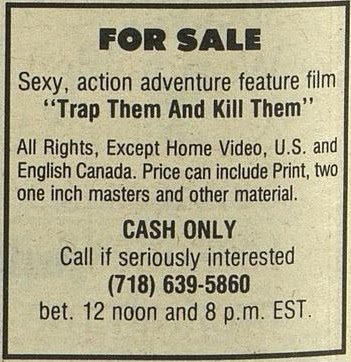
The Italian sexploitation cannibal flick EMANUELLE E GLI ULTIMI CANNIBALI/EMANUELLE AND THE LAST CANNIBALS (1977) was picked up for U.S. distribution in 1983 by Megastar Pictures of Queens, New York, and the title was changed to TRAP THEM AND KILL THEM. The above ad is from its November 30, 1984 showing at the Fabian 5 Theater in Paterson, New Jersey, but Megastar's sole 35mm print had actually premiered at the 42nd Street Liberty Theater on June 1, on a double bill with STRANGE BEHAVIOR. After six weeks at the Liberty, the print toured other theaters in the area including the RKO Fordham in the Bronx on October 5. After the run at the Fabian, the print went to the RKO Kenmore in Brooklyn (January 25, 1985), the RKO Coliseum in Washington Heights (February 8), and elsewhere. The film was released on home video in March '85 via Trans World Entertainment's horror label, Twilight Video, but that didn't stop its theatrical life and it returned to the Liberty on May 23, 1986 on a triple bill with SHOCKING CANNIBALS (a re-release of MONDO MAGIC) and DOOMED TO DIE (a.k.a. Umberto Lenzi's EATEN ALIVE). It hit the Liberty one last time, in January 1987, on a double bill with Lamberto Bava's MONSTER SHARK, before Megastar ran the following ad in Variety on February 25, 1987...
Evidently there weren't many who were seriously interested, so a year and a half later Megastar submitted a cut version to the MPAA under the title EMANUELLE'S AMAZON ADVENTURE, received an R rating, and licensed the film to Showtime for its "After Hours" programming until the mid '90s.
Thursday, September 10, 2020
KOGARASHI MONJIRO: WITHERED TREE and SECRET OF MONJIRO'S BIRTH (both 1972)
Vagabond gambler Monjiro (Bunta Sugawara) is tricked into serving time at Miyake Island penal colony for a yakuza killing he didn't commit, then escapes to track down the former friend who betrayed him. In addition to his superior swordsmanship, Monjiro can also turn his homemade toothpicks into projectile eyeball skewers. The awkward structuring in the first act was probably done in post-production to fix pacing issues; it annoyed me both times I watched the film, which is otherwise a stylish, compelling combination of matatabi eiga and prison escape actioner. The title was MONJIRO THE DEADLY SWORDSMAN when it opened in Honolulu on November 15, 1972. Based on the novel Kogarashi Monjirō by Saho Sasazawa, its success spawned a sequel later the same year, KOGARASHI MONJIRO 2: SECRET OF MONJIRO'S BIRTH.
In the sequel, the wandering swordsman finds his long-lost older sister Omitsu (Etsuko Ichihara) working in a brothel, rescues novice gambler Tsunehei (Kunie Tanaka) from murderous bandits, and dodges hired swords in the employ of the vengeful Imai Group, whose boss was killed by Monjiro in a yakuza duel. The title is a misnomer – there's not much of a “secret” here – but the Toshiaki Tsushima score is really good, the swordplay and eyeball piercing projectile toothpicks still work the second time around, and I wish every sequel had Kunie Tanaka and Kyosuke Machida in it. I'm surprised these Monjiro adventures didn't play the U.S. samurai circuit of the '70s, because they're just as good as some of the ones that did make the rounds (the SHADOW HUNTERS and TRAIL OF BLOOD films, for example). This was Sugawara's second and last time playing Monjiro. However, Atsuo Nakamura took over the role later the same year for a television series that was written and directed by Kon Ichikawa, and two decades later Nakamura and Ichikawa brought the character back for a 1993 feature, KAETTEKITE KOGARASHI MONJIRO.
Labels:
BUNTA SUGAWARA,
THESE FISTS BREAK BRICKS,
TOEI
Wednesday, September 09, 2020
Sunday, September 06, 2020
Movie Ad of the Week: FUTUREKICK (1991)
The sci-fi kickboxer pic FUTUREKICK, starring Don "The Dragon" Wilson, opened at the Ford Wyoming Drive-In in Detroit on September 6, 1991 -- 29 years ago today!
Saturday, September 05, 2020
Mystery Movie Solved! THE FOUR OF US
Last month we posted about two mystery movies from Group 1 Films, and within a few days Marc Edward Heuck figured out the true identity of GIRLS IN TROUBLE. Now, exactly one month after our original post, longtime Temple contributor Mike MacCollum has solved the other mystery! Thanks to a super bit of sleuthing by Mike, we've confirmed that THE FOUR OF US is JEUX POUR COUPLES INFIDÈLES (1972) a.k.a. SENSUAL DESIRES, HOT AND BLUE and FRENCH SEXY-GO-ROUND, directed by Jean Desvilles and starring Pierre Rousseau and Danièle Vlaminck. Excellent work, Mike!
Wednesday, September 02, 2020
THE GREAT HITCH-HIKE RACE (1972)
From the Temple Vault: Our pal Mike MacCollum wrote the following review back in June 2016, but we never got around to running it that summer. I found an email to Mike a couple of months later in which I mention including it in a 30th anniversary issue of Temple of Schlock that I was planning for July 2017, but that didn't happen either. I guess I'd forgotten about it by the time I went on a hiatus in August 2018 that ended up lasting two years -- and now here we are in September 2020, with a review of a movie that still has no IMDb entry more than four years after the screening Mike attended. Enjoy!
I gripe a lot about all the movies that don't make it to theaters in Indianapolis – the art movies that don't play here, the horror and science fiction movies, the Chinese films, and (to name one title in particular) the 70mm version of THE HATEFUL EIGHT. I can understand why this happens, but it doesn't mean I have to like it.
Still, even a complainer like me has to acknowledge the bright spots on the Indy-area theatrical scene, and one of the brighter lights, to my mind, is Shelbyville's Skyline Drive-In. It takes about 45-50 minutes to get there from where I live, and I don't get to go out there nearly as often as I would like, for various reasons, but I make the drive whenever I can.
In addition to weekend-long events like the Super Monster Movie Fest and the Pandemonium Picture Show, the Skyline also offers a (mostly) weekly feature called Drive-InSanity – drive-in movies from the past, shown on 35mm film, as a third (or sometimes fourth) movie, late Saturday night or (much more frequently) early Sunday morning. Last year [2015], the offerings included THE SAVAGE RIDERS and a kung fu movie called THE BAD AND THE BLOODY, which turned out to be DA XIAO TONG CHI/WIN THEM ALL (1973) . So far this season, CREATION OF THE HUMANOIDS, BEYOND EVIL, THE WEIRD WORLD OF LSD, JAWS OF THE DRAGON and THE DARK (1979), among others, have been shown.
All of the above are likely fairly easy to see these days, in one way or another. But THE GREAT HITCH-HIKE RACE, the Drive-In Sanity title for the first week of June, is another matter altogether. Like THE SAVAGE RIDERS and THE BAD AND THE BLOODY from last year, this was a real obscurity – barely released back in the day, and apparently impossible to see, otherwise.
I was getting over a throat infection at the time, so driving out to Shelbyville and then driving back just before the sun came up might not have been a great idea.
Of course, I went anyway.
I slept through most of the latest X-MEN movie, but got up in time for the end credits. After a brief break, it was time for THE GREAT HITCH-HIKE RACE.
So how was it? Well, don't expect to rediscover a lost classic, or much of a good movie of any kind. I did like a few aspects of the movie, and I will mention those in a while. But first....
If you're going to call a movie THE GREAT HITCH-HIKE RACE, you kind of make the potential viewer expect some sort of a competition, with something at stake. And yes, even though the potential destruction of a huge smokestack is a possibility here, there is no race of any kind- not two people (or groups of people) racing each other, not a race against time... and not a lot of excitement. The title may have been an attempt to put make audiences think of the much higher profile THE GREAT RACE from the previous decade- but even if you knew you shouldn't expect big stars, big slapstick set pieces, and a big budget from THE GREAT HITCH-HIKE RACE, you would be forgiven for expecting the movie to deliver... some sort of entertainment. And by and large, it does not.
The main problem is the script, which seems to have been written in haste, or at least without much effort. Most of the would-be laugh lines sound decades old, some of them possibly dating back to the heyday of vaudeville. (The scenes featuring the squabbling mother and stepfather of Chick are especially bad; almost all of their lines seem to be really old hat, and probably weren't very funny even when they were new.) On top of that, even if he had thought up more genuinely fresh and funny dialogue, director/writer Erven Jourdan apparently didn't seem to know how to film comedic scenes very effectively, if THE GREAT HITCH-HIKE RACE is a fair representation of his work. As it is, some of the lines in the script have comedic potential, but most of these bits still come across as unfunny, due to flat and unimaginative presentation.
The film is also a very meek and mild-mannered, rarely even living up to its PG rating. Yes, there are some shots of Laurie performing as a (fully clothed) go-go dancer, along with the scenes visualizing Chick's would-be seduction of Laurie (in which she wears a red, full-length body stocking). And while I do recall that Chick and Pete talk about smoking pot, I don't think it was a very long discussion, and I don't think anyone smokes marijuana on screen. Apart from those scenes, and a few brief bits of dialogue about whether or not any of the young men got lucky with the ladies, I think THE GREAT HITCH-HIKE RACE could have been rated G. It makes you wonder what sort of audience Jourdan was trying to attract when his movie has about as much bite as a segment of LOVE, AMERICAN STYLE.
And while the film does show that the young characters are concerned about pollution and the environment, other issues of the day barely rate a mention. As I recall, several women in the group with Hawk, Chick and Pete object when Hawk says that only men can go on the mission. But (again, as I recall) Hawk shuts them down pretty quickly, and apart from a possible fleeting comment or two from Laurie, and/or a friend of hers, that's about as close as the movie comes to saying much of anything about feminism or women's rights.
But if THE GREAT HITCH-HIKE RACE says very little about the role of women in society, it says nothing -- or at least nothing that stuck in my memory -- about racism or Vietnam. The latter omission makes it seem like the movie is taking place in an alternate universe, since the real-life counterparts of Hawk, Chick and Pete almost certainly would talk about the war at some point, especially if they were trying to come up with a target for a protest action. And while several black people appear in the film as extras in street scenes, I don't think that even one African-American actor has a speaking role in the film. There may have been one black person in the first few scenes, where Hawk and his friends discuss smog and pollution; if so, it wasn't something I was paying attention to at the time, but as the film went along I certainly did notice that there were not any (more) black performers with speaking parts, and that did seem odd.
In any event, while Jourdan may have been trying to maintain a light and comic tone by avoiding potentially divisive issues, it doesn't really work, especially since THE GREAT HITCH-HIKE RACE isn't very funny in the first place. Instead, this makes a film that is already far too mild seem even more tame and insubstantial.
As for the characters, most aren't on screen long enough to make much of an impression, but a few -- mainly Chick's mother and stepfather -- are annoying and unfunny for most or all of their time on screen (Again, the script should be blamed for this, rather than the actors). As for Hawk and the others in "his" group, at the very start of the film, they seem to be lively, yippie-ish anti-establishmentarians, coming up with the smokestack plan, pulling a prank on the local police, and screwing around with the media after a (fairly rapid, apparently) trial or hearing that resulted from their actions regarding the police. They certainly don't come across as perfect -- Hawk seems to have a problem with women, Hawk selfishly refuses to go on the mission, and some members of the group don't seem to be terribly bright (indeed, the prank itself is more daring than smart, since it quite possibly could have had some horrible unintended consequences) -- but at least it seems like the young people (and Jourdan himself) will continue to do things that might provoke at least some audience members, and it seems like the film might have some bite.
But once the (overlong) trek south gets underway, that pretty much goes out the window. Hawk, Chick, and Pete start to seem like fairly hapless losers, in many ways- Hawk confesses that he is a virgin, and admits that he doesn't know how to talk to women; Pete just sits in the cab of the pickup as it drives off, helplessly staring out the back window at Chick, rather than yelling and pounding on the rear window of the truck to let the driver know that he's trapped inside; Hawk gets fired from his entry level job; Chick dozes off after Laurie brings him back to her apartment, when she clearly has something beyond mere sleep on her mind; the plan to blow up the smokestack is shown to be totally counterproductive, since it just would lead to more pollution; and in one of the last scenes, Hawk (or possibly Chick; I've forgotten) does something unbelievably stupid. (No details here, since that would be a major spoiler; suffice it to say that I thought that the consequences would be pretty bad, and they were -- just not in the way that I expected.)
And yet, even with the generally ineffective attempts at comedy and the overall mildness, THE GREAT HITCH-HIKE RACE isn't without a few points in its favor. For one thing, I thought that it was interesting as a time capsule of sorts, buried (figuratively) and forgotten for years, at least in terms of the clothes, hair, cars, and settings. On the other hand, compared to THE SAVAGE RIDERS, the other time capsule movie I've seen at the Skyline, this one just didn't cut the mustard. "You just don't dig the situation" was the only line of dialogue that I bothered to write down, versus at least nine or ten lines from THE SAVAGE RIDERS, and each of the lines from RIDERS was much more colorful and memorable than that one rather generic line from THE GREAT HITCH-HIKE RACE.
Also, Tony Elam and Annie Latham manage to give good performances as Chick and Laurie, in spite of the script (too bad she has only two credits on the IMDb, while he has none, as far as I can see, since THE GREAT HITCH-HIKE RACE has no entry as of yet); I liked/really liked both of the Lemon Dips songs heard in the film, "Travelin' Man" and "Unpack Your Bags" (the latter was a bit too flower-powery for my taste, but it did work well as used in the film); Lydy Henley, as Chick's mother, effectively registers concern for her son near the end of the movie; and there were a few times when I actually smiled, or possibly even laughed (the sleepy drunk driver; the visualization of Chick's made-up account of his night with Laurie; and the way that the fate of Laurie's car is depicted).
I also should note that one of the other cars that stayed for THE GREAT HITCH-HIKE RACE was parked fairly close to mine, and someone in that car was laughing fairly frequently throughout the film, so maybe I was just feeling poorly that morning, and/or just didn't appreciate the movie. If and when this film becomes more widely available, I look forward to seeing others' opinions, along with finding out all of the details I missed (or just plain got wrong). And of course, I also look forward to whatever else the Skyline and Drive-InSanity will be bringing to central Indiana the rest of the season.
Review by Mike MacCollum
I gripe a lot about all the movies that don't make it to theaters in Indianapolis – the art movies that don't play here, the horror and science fiction movies, the Chinese films, and (to name one title in particular) the 70mm version of THE HATEFUL EIGHT. I can understand why this happens, but it doesn't mean I have to like it.
Still, even a complainer like me has to acknowledge the bright spots on the Indy-area theatrical scene, and one of the brighter lights, to my mind, is Shelbyville's Skyline Drive-In. It takes about 45-50 minutes to get there from where I live, and I don't get to go out there nearly as often as I would like, for various reasons, but I make the drive whenever I can.
In addition to weekend-long events like the Super Monster Movie Fest and the Pandemonium Picture Show, the Skyline also offers a (mostly) weekly feature called Drive-InSanity – drive-in movies from the past, shown on 35mm film, as a third (or sometimes fourth) movie, late Saturday night or (much more frequently) early Sunday morning. Last year [2015], the offerings included THE SAVAGE RIDERS and a kung fu movie called THE BAD AND THE BLOODY, which turned out to be DA XIAO TONG CHI/WIN THEM ALL (1973) . So far this season, CREATION OF THE HUMANOIDS, BEYOND EVIL, THE WEIRD WORLD OF LSD, JAWS OF THE DRAGON and THE DARK (1979), among others, have been shown.
All of the above are likely fairly easy to see these days, in one way or another. But THE GREAT HITCH-HIKE RACE, the Drive-In Sanity title for the first week of June, is another matter altogether. Like THE SAVAGE RIDERS and THE BAD AND THE BLOODY from last year, this was a real obscurity – barely released back in the day, and apparently impossible to see, otherwise.
I was getting over a throat infection at the time, so driving out to Shelbyville and then driving back just before the sun came up might not have been a great idea.
Of course, I went anyway.
I slept through most of the latest X-MEN movie, but got up in time for the end credits. After a brief break, it was time for THE GREAT HITCH-HIKE RACE.
So how was it? Well, don't expect to rediscover a lost classic, or much of a good movie of any kind. I did like a few aspects of the movie, and I will mention those in a while. But first....
If you're going to call a movie THE GREAT HITCH-HIKE RACE, you kind of make the potential viewer expect some sort of a competition, with something at stake. And yes, even though the potential destruction of a huge smokestack is a possibility here, there is no race of any kind- not two people (or groups of people) racing each other, not a race against time... and not a lot of excitement. The title may have been an attempt to put make audiences think of the much higher profile THE GREAT RACE from the previous decade- but even if you knew you shouldn't expect big stars, big slapstick set pieces, and a big budget from THE GREAT HITCH-HIKE RACE, you would be forgiven for expecting the movie to deliver... some sort of entertainment. And by and large, it does not.
The main problem is the script, which seems to have been written in haste, or at least without much effort. Most of the would-be laugh lines sound decades old, some of them possibly dating back to the heyday of vaudeville. (The scenes featuring the squabbling mother and stepfather of Chick are especially bad; almost all of their lines seem to be really old hat, and probably weren't very funny even when they were new.) On top of that, even if he had thought up more genuinely fresh and funny dialogue, director/writer Erven Jourdan apparently didn't seem to know how to film comedic scenes very effectively, if THE GREAT HITCH-HIKE RACE is a fair representation of his work. As it is, some of the lines in the script have comedic potential, but most of these bits still come across as unfunny, due to flat and unimaginative presentation.
The film is also a very meek and mild-mannered, rarely even living up to its PG rating. Yes, there are some shots of Laurie performing as a (fully clothed) go-go dancer, along with the scenes visualizing Chick's would-be seduction of Laurie (in which she wears a red, full-length body stocking). And while I do recall that Chick and Pete talk about smoking pot, I don't think it was a very long discussion, and I don't think anyone smokes marijuana on screen. Apart from those scenes, and a few brief bits of dialogue about whether or not any of the young men got lucky with the ladies, I think THE GREAT HITCH-HIKE RACE could have been rated G. It makes you wonder what sort of audience Jourdan was trying to attract when his movie has about as much bite as a segment of LOVE, AMERICAN STYLE.
And while the film does show that the young characters are concerned about pollution and the environment, other issues of the day barely rate a mention. As I recall, several women in the group with Hawk, Chick and Pete object when Hawk says that only men can go on the mission. But (again, as I recall) Hawk shuts them down pretty quickly, and apart from a possible fleeting comment or two from Laurie, and/or a friend of hers, that's about as close as the movie comes to saying much of anything about feminism or women's rights.
But if THE GREAT HITCH-HIKE RACE says very little about the role of women in society, it says nothing -- or at least nothing that stuck in my memory -- about racism or Vietnam. The latter omission makes it seem like the movie is taking place in an alternate universe, since the real-life counterparts of Hawk, Chick and Pete almost certainly would talk about the war at some point, especially if they were trying to come up with a target for a protest action. And while several black people appear in the film as extras in street scenes, I don't think that even one African-American actor has a speaking role in the film. There may have been one black person in the first few scenes, where Hawk and his friends discuss smog and pollution; if so, it wasn't something I was paying attention to at the time, but as the film went along I certainly did notice that there were not any (more) black performers with speaking parts, and that did seem odd.
In any event, while Jourdan may have been trying to maintain a light and comic tone by avoiding potentially divisive issues, it doesn't really work, especially since THE GREAT HITCH-HIKE RACE isn't very funny in the first place. Instead, this makes a film that is already far too mild seem even more tame and insubstantial.
As for the characters, most aren't on screen long enough to make much of an impression, but a few -- mainly Chick's mother and stepfather -- are annoying and unfunny for most or all of their time on screen (Again, the script should be blamed for this, rather than the actors). As for Hawk and the others in "his" group, at the very start of the film, they seem to be lively, yippie-ish anti-establishmentarians, coming up with the smokestack plan, pulling a prank on the local police, and screwing around with the media after a (fairly rapid, apparently) trial or hearing that resulted from their actions regarding the police. They certainly don't come across as perfect -- Hawk seems to have a problem with women, Hawk selfishly refuses to go on the mission, and some members of the group don't seem to be terribly bright (indeed, the prank itself is more daring than smart, since it quite possibly could have had some horrible unintended consequences) -- but at least it seems like the young people (and Jourdan himself) will continue to do things that might provoke at least some audience members, and it seems like the film might have some bite.
But once the (overlong) trek south gets underway, that pretty much goes out the window. Hawk, Chick, and Pete start to seem like fairly hapless losers, in many ways- Hawk confesses that he is a virgin, and admits that he doesn't know how to talk to women; Pete just sits in the cab of the pickup as it drives off, helplessly staring out the back window at Chick, rather than yelling and pounding on the rear window of the truck to let the driver know that he's trapped inside; Hawk gets fired from his entry level job; Chick dozes off after Laurie brings him back to her apartment, when she clearly has something beyond mere sleep on her mind; the plan to blow up the smokestack is shown to be totally counterproductive, since it just would lead to more pollution; and in one of the last scenes, Hawk (or possibly Chick; I've forgotten) does something unbelievably stupid. (No details here, since that would be a major spoiler; suffice it to say that I thought that the consequences would be pretty bad, and they were -- just not in the way that I expected.)
And yet, even with the generally ineffective attempts at comedy and the overall mildness, THE GREAT HITCH-HIKE RACE isn't without a few points in its favor. For one thing, I thought that it was interesting as a time capsule of sorts, buried (figuratively) and forgotten for years, at least in terms of the clothes, hair, cars, and settings. On the other hand, compared to THE SAVAGE RIDERS, the other time capsule movie I've seen at the Skyline, this one just didn't cut the mustard. "You just don't dig the situation" was the only line of dialogue that I bothered to write down, versus at least nine or ten lines from THE SAVAGE RIDERS, and each of the lines from RIDERS was much more colorful and memorable than that one rather generic line from THE GREAT HITCH-HIKE RACE.
Also, Tony Elam and Annie Latham manage to give good performances as Chick and Laurie, in spite of the script (too bad she has only two credits on the IMDb, while he has none, as far as I can see, since THE GREAT HITCH-HIKE RACE has no entry as of yet); I liked/really liked both of the Lemon Dips songs heard in the film, "Travelin' Man" and "Unpack Your Bags" (the latter was a bit too flower-powery for my taste, but it did work well as used in the film); Lydy Henley, as Chick's mother, effectively registers concern for her son near the end of the movie; and there were a few times when I actually smiled, or possibly even laughed (the sleepy drunk driver; the visualization of Chick's made-up account of his night with Laurie; and the way that the fate of Laurie's car is depicted).
I also should note that one of the other cars that stayed for THE GREAT HITCH-HIKE RACE was parked fairly close to mine, and someone in that car was laughing fairly frequently throughout the film, so maybe I was just feeling poorly that morning, and/or just didn't appreciate the movie. If and when this film becomes more widely available, I look forward to seeing others' opinions, along with finding out all of the details I missed (or just plain got wrong). And of course, I also look forward to whatever else the Skyline and Drive-InSanity will be bringing to central Indiana the rest of the season.
Sunday, August 30, 2020
Movie Ads of the Week: THE HAUNTED WOMAN a.k.a. TATTOOED SWORDSWOMAN (1971)
Best known today as BLIND WOMAN'S CURSE, Teruo Ishii's weird yakuza horror pic KAIDAN NOBORI RYU, starring Meiko Kaji, opened at the Toho Theatre in Honolulu as THE HAUNTED WOMAN on September 22, 1971.
A month and a half earlier, it had opened at the Toho La Brea Theatre in L.A. as TATTOOED SWORDSWOMAN, co-billed with THE VAMPIRE DOLL, on August 6, 1971.
Kevin Thomas' review in the Los Angeles Times was positive.
This double feature also played at the Bijou in New York City beginning January 19, 1972.
TATTOOED SWORDSWOMAN was screened at the Elgin Theater and Bleecker Street Cinema several times and played numerous samurai and Japanese film festivals for the rest of the decade, most notably the 10-week Cinema East festival at the Regency Theatre in New York (April 14-June 22, 1974), where it screened with the first RED PEONY GAMBLER movie (under the title LADY YAKUZA)...
...and Samurai, A Film Festival at the Entermedia Theatre in New York (November 21, 1980-January 3, 1981).
It also received a positive review (and A-III rating) in The Catholic Film Newsletter!
A month and a half earlier, it had opened at the Toho La Brea Theatre in L.A. as TATTOOED SWORDSWOMAN, co-billed with THE VAMPIRE DOLL, on August 6, 1971.
Kevin Thomas' review in the Los Angeles Times was positive.
This double feature also played at the Bijou in New York City beginning January 19, 1972.
TATTOOED SWORDSWOMAN was screened at the Elgin Theater and Bleecker Street Cinema several times and played numerous samurai and Japanese film festivals for the rest of the decade, most notably the 10-week Cinema East festival at the Regency Theatre in New York (April 14-June 22, 1974), where it screened with the first RED PEONY GAMBLER movie (under the title LADY YAKUZA)...
...and Samurai, A Film Festival at the Entermedia Theatre in New York (November 21, 1980-January 3, 1981).
It also received a positive review (and A-III rating) in The Catholic Film Newsletter!
Saturday, August 29, 2020
KARATE KILLER (1973)
Remember the scene in THE BODYGUARD where Sonny Chiba punches through a door, rips off an assassin's arm, pulls the bloody arm through the hole in the door, then kicks open said door, charges into the room and flings the arm at another assassin, knocking him on his ass? Nothing in this sequel even comes close to that level of savage hilarity, though I'm happy to report that it is a better film overall. It certainly moves faster than the first one. Bodyguard Kiba destroys special guest star Masashi Ishibashi for blinding his sister Maki (Etsuko Shihomi) during a dispute between karate schools, gets sent to prison, befriends Okinawan crook Nanjo (Tsunehiko Watase) behind bars, is let out of prison and picked up by a beautiful woman (Yukiko Kuwahara) with a job offer, all in the first 10 minutes! Kiba's latest gig is protecting nightclub owner Akamatsu (Akiyoshi Fukae) from backstabbing business partner Tatsumi (Hideo Murata) and his pack of karate thugs. Years earlier, both men were part of a team that killed some American MPs during a robbery of $420,000 and double-crossed Nanjo, who has just been released from prison and is looking for his share of the loot. There are a few too many coincidences in the storytelling, and for a movie called KARATE KILLER it seems a little light on karate, but it's never boring and the bit where one of Tatsumi's thugs tries his hardest not to pour a beer for Chiba is very funny.
Labels:
SONNY CHIBA,
SUE SHIOMI,
THESE FISTS BREAK BRICKS,
TOEI
Wednesday, August 26, 2020
Sunday, August 23, 2020
Movie Ad of the Week: BEAST OF THE YELLOW NIGHT w/ THE DEVIL'S CRYPT and CREATURE WITH THE BLUE HAND (1975)
Shortly after New World Pictures acquired the Filipino production BEAST OF THE YELLOW NIGHT, company heads Roger Corman and Larry Woolner decided it needed a co-feature, so Woolner made a deal with Sam Sherman of Independent-International Pictures to license the German-made CREATURE WITH THE BLUE HAND from him. Four years later, when Woolner was running Dimension Pictures, he reissued the two films with the Italian horror movie THE DEVIL'S WEDDING NIGHT (under the new title THE DEVIL'S CRYPT) on a "Triple Terror!" program that played in Buffalo, NY on April 18, 1975.
Friday, August 21, 2020
GAMBLER: VICTORY WITHOUT DEATH (1967)
Here's a nice change of pace: a Toei 'gambler' movie that actually has gambling in it. No hanafuda games either -- this one is about tausagi, a dice game that originated in Kumamoto. Koji Tsuruta, our new favorite actor, plays Tsunetaro Asakura, a notorious South Kyushu gambler better known as Dynamite Tsune who has come to Chikuho looking for "a rich game of tausagi" and finds it at the home of Kaichi Ishijima (Tomisaburo Wakayama), owner of the Ishijima Coal Mine and head of the Chikuho Miners Association. Tsune loses all of his money plus a bundle loaned to him by Sugi Hanamura (Michiyo Kogure), president of Hanamura Shipping, so he goes to work for coal mine owner Arao (Kenjiro Ishiyama) as a chief foreman until he can win big and repay his debt. Meanwhile, Ishijima has been sending association goons to rough up Hanamura's stevedores in an attempt to get her to lower the fees for coal shipments, and also muscling in on Arao's deal with Hanshin Steel by promising to hook up the company president's idiot son Yoshio (Kanbi Fujiyama) with Arao's daughter Aya (Masumi Tachibana), who only has eyes for Dynamite. No need for spoiler warnings here; you've probably already guessed that there's a mine cave-in and rescue sequence, and the only way the story's going to end is with Tsune (a) wagering his life on the roll of the dice, (b) slamming his tantō into a dozen tattooed torsos, or (c) both a and b. Maybe, like me, you'll have so much fun you won't care how predictable it all is.
Thursday, August 20, 2020
THREE GAMBLERS (1967)
Viewers expecting just another ninkyo eiga from Toei will be disoriented by this film's opening shot: a pullback from Our Lady of Penha Chapel to one of the 32 cannons atop the Fortaleza do Monte in Macao. Yes, this is certainly shaping up to be Shigehiro Ozawa Week here at the Temple, isn't it? And I only have 60 or 70 more of his movies to watch.
Four years after killing each other's boss -- and nearly killing each other with axes during work detail -- Naojiro (Koji Tsuruta) and Sugiyama (Kyôsuke Machida) emerge from Abashiri Prison as sworn brothers and head home to Yokohama. Sugiyama's clan has been disbanded thanks to the rotten Koizumi brothers (Toru Abe and Shigeyoshi Fujioka), the same thugs who sent the visiting Naojiro to do their killing for them. Naojiro quickly discovers that his wife Osata, who was pregnant at the time he fulfilled his yakuza obligation, was sold into prostitution by the same damn Koizumi creeps as part of a deal that involves sending teenage girls to flesh-peddling Mr. Chow (Hôsei Komatsu) in Macao in exchange for opium. So Naojiro and Sugiyama set out for Macao to find Osata and wipe out the Koizumi-Chow connection --
"But wait!" you say, "I only count two gamblers! Who's the third?"
That would be Nagano (the great Ryō Ikebe from PALE FLOWER), a wife killer with terminal lung disease who's been dispatched by the brothers Koizumi to kill Naojiro -- and also happens to be sworn brothers with Sugiyama.
Maybe I'm overrating these Ozawa-Tsuruta collaborations (there were at least 30 of them) but they really scratch the Don Siegel-Phil Karlson itch for me, plus the comic relief characters that pop in every so often are actually funny. This time it's a chubby rickshaw driver who idolizes Naojiro and Sugiyama ("Japanese gangsters are so cool"). I also like how "mafia" starts showing up in the subtitling instead of "yakuza," and the machine gun's a nice addition as well -- which reminds me: I'm probably never going to grow tired of seeing Toru Abe get his bloody comeuppance.
Wednesday, August 19, 2020
GAMBLERS AND RACKETEERS (1964)
The Kikuya Group, run by Boss Kijima (Chiezō Kataoka), controls a large share of the street vendor business in Asakusa but is beginning to feel the squeeze, both from a rival yakuza gang trying to muscle in on their turf as well as a supermarket that's due to be constructed in the neighborhood. Kijima's older son Ryutaro (Koji Tsuruta) has been disowned for killing another Kikuya member in a drunken rage and is now eking out a living as a bodyguard while staying on good terms with his immature younger brother Katsuo (Hiroki Matsukata) and school chum Mizuno (Minoru Oki), now Kikuya's second-in-command. Tetsurō Tamba plays another childhood pal, an understanding cop trying to keep Ryutaro and Katsuo out of jail. Director Shigehiro Ozawa is dismissed as "mediocre" in Paul Schrader's 1974 Film Comment article "Yakuza-Eiga: A Primer" but he was a better than average studio craftsman, as adept at handling the humor and pathos as he was at staging dynamic action sequences. This feels a lot more confined to studio sets than the other films of his I've seen, most likely a budgetary decision but one that also works thematically given the constricted lives of its characters. Tsuruta is excellent, particularly in the scene in which he reveals the true reasons for his banishment to Matsukata. When this opened in Honolulu in March 1965 the title was CRIME STREET, TOKYO.
Labels:
JUNKO FUJI,
KOJI TSURUTA,
MINORU OKI,
SHIGEHIRO OZAWA,
TATSUO ENDO,
TETSURO TANBA,
TOEI
Tuesday, August 18, 2020
A WAD OF NOTES (1970)
Vagabond gambler Ryuji (Koji Tsuruta) returns to his hometown of Tobata after learning from bumbling con men Kinpachi (Asao Koike) and Toramatsu (Rinichi Yamamoto) that two competing yakuza outfits, Naomasa and Mojitoku, are vying for control of the city's annual Gion Yamagasa festival, which for generations has been the responsibility of the Wakashu Union. Thirteen years earlier, Boss Wakashu's son Sanjiro (Minoru Oki) killed a few gang members during an attempted takeover, but Ryuji willingly went to prison for the crime so it wouldn't tarnish the union's reputation and compromise its control of the festival. Sanjiro has since gone blind and finding it difficult to retain control, so Ryuji schemes with Kinpachi and Toramatsu to destroy both Naomasa and Mojitoku by turning them against each other. His YOJIMBO-like plan hits a snag when he befriends lady gambler Sen (Akiko Kudô), who is indebted to Mojitoku, and further complications arise when Tetsugoro the killer (Bin Amatsu) shows up seeking revenge for his older brother, one of the gang members killed by Sanjiro. Highly entertaining, with a couple of exciting, bloody sword and gun battles and a believable relationship between Tsuruta and Kudô. This highly entertaining ninkyo from the reliable Shigehiro Ozawa really hits the sweet spot, with a cast full of familiar faces, a typically convoluted but compelling storyline, exciting action scenes and an engaging, believable performance by Kudô. Originally titled FUDATSUKI BAKUTO, it opened in Honolulu on December 29, 1970 as FESTIVAL OF LANTERNS.
Labels:
KOJI TSURUTA,
MINORU OKI,
SHIGEHIRO OZAWA,
TOEI
Monday, August 17, 2020
PROFESSIONAL KILLERS (1973)
This feels like a TV pilot but it's actually a feature film based on a concurrent television series, yet it's so well done that someone who's unfamiliar with the show and its characters can drop in and easily be brought up to speed. The premise is great: respected merchant Otowaya Hanyemon (So Yamamura) runs an assassination bureau in Edo with bachelor acupuncturist Dr. Baian Fujieda (Jirô Tamiya) and ronin Sanai Nishimura (Kôji Takahashi), a family man whose legit front is a blade polishing/sharpening business. Their main stipulation is that they only eliminate individuals who are predatory and a detriment to society. What starts off as a simple job -- rubbing out the scheming second wife of a local wholesale candle merchant -- leads to the killers accepting several additional contracts, including a corrupt magistrate (Hideo Murata) who wants to hire Sanai as his deputy and a deceitful widow (Yôko Nogiwa) who might be Baian's long-lost sister. The female contracts usually go to Baian, since he's handsome and something of a lady-killer already; he attacks from behind with his needles, while Sanai prefers male victims he can challenge with his sword. I liked this so much I watched it twice in one week, and will definitely buy the two sequels, PROFESSIONAL KILLERS: ASSASSIN'S QUARRY (1973) and PROFESSIONAL KILLERS: ASSIGNMENT BY NIGHT (1974), as well as the complete TV series when/if they ever come out on Blu-ray or DVD.
Sunday, August 16, 2020
Subscribe to:
Posts (Atom)