Originally published in
The Miami Herald, April 13, 1974, p. 6-B
You walk into the theater ready to sneer, prepared to laugh out loud in all the wrong places -– but you don’t. Three years and many disappointments later, Jackie Mason’s “The Stoolie” has made its way into its first commercial theater, attracting a handful of local actors and extras who appear in the Miami-made film and many more curious who arrive wondering just how bad a film starring Mason will be.
Well, like the old ads in the magazines about the doubters “who laughed when he sat down to play,” the curious aren’t laughing at Mason anymore.
“The Stoolie,” produced and bankrolled by Mason, an insult comedian with an acid tongue and surly image, and John Avildsen, the young director of “Joe” and “Save the Tiger,” is a major surprise and a major work.
For all the right reasons, too. Even when “The Stoolie” temporarily falters, it does so because of qualities, not defects.
So why hasn’t “The Stoolie” been released before now if it’s a good picture? Some professionals suggest it may be too good to achieve commercial success, that “The Stoolie” is too honest and uncompromising for the times.
This could be so. When the film loses some of its charm late in the story, it is not because of those widely publicized off-camera arguments between Avildsen and Mason that led to the director’s dismissal, nor is it because of the actors cannot sustain their delicate and engaging love story. “The Stoolie,” a story of two ugly ducklings who fall in love on Miami Beach, eventually becomes a triangle involving not two, but three, downbeat characters. Dan Frazer, playing a sour and seedy New Jersey detective, provides a comedic subplot during the first two-thirds of the film, but when teamed with Mason and actress Marcia Jean Kurtz, adds sandpaper when we require velvet.
Even so, we leave the Normandy Theater impressed. We are impressed with Mason, who is Chaplinesque in his surprisingly strong portrayal of a small-time hood and stool pigeon, and we are impressed with Avildsen, who’s crafted yet another film of excellence, even if the bearded director wasn’t around for those final scenes.
I also like “The Stoolie” because it does not shortchange us: Promising the offbeat, it delivers more than that – a poignant love story that tells us it is never too late to change, no matter how ugly, dirty, hounded or unloved one might be. And despite the very low budget (under $650,000), the Mason-Avildsen film looks good. If it were French, Mason could enter his work in a film festival, win a few prizes, earn a rave Pauline Kael review. At the moment, Mason will have to hope that Miamians spread the word.
“The Stoolie” begins with a scene in a warehouse in which two burly hoods are seen unloading a hijacked truck that’s packed with stolen color television sets. Roger Pittman (Mason), looking like an armpit with legs, meekly asks for his $1,000 payoff. The hoods hand Roger $50. The other $950? “We took out withholding tax,” the one thug sneers. Roger asks for a color TV. He gets it – on the floor. “Gee, that one sounds broken,” one of the men says.
Roger becomes a stool pigeon, a police informant, loathed by lawmen and law breakers alike. When he visits a detective’s rundown little apartment to collect a payoff, the cop tells Roger never to come to his apartment again.
“You’re just turned off because I found out you live as crummy as I do,” Roger says to the cop.
“Roger,” comes the weary answer. “No one lives as crummy as you.”
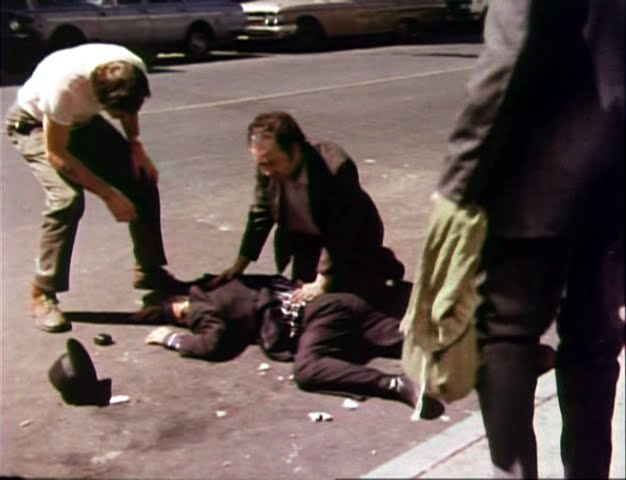
A few days later another smalltime hood, set up by Roger, attempts to flee the detective but is run down in the street by a truck. “Don’t worry about it,” the cop says to the truck driver, as both gaze at the body. “A small time creep. He’s nothing.”
For Roger, it is like looking into a mirror. After burying the hood, Roger steals $7500 in police department funds and heads for Miami, and at this point the mood and texture of the film, grainy and ill-lit and sordid, undergoes a dramatic change. Mason goes to the Doral Hotel, accompanied in the soundtrack by princely music. The doors snap open, as if jumping to attention. The extravagant luxury of the hotel draw dwarfs the seedy little man.

The adventures of Roger of Miami Beach (the original title of the film), begins as Avildsen’s remarkable camera stalks the vulgarity and the beauty of Miami Beach and South Florida. The Mason-Avildsen portrait of South Florida is a revealing one, with friendly valentines repeatedly followed by hard kicks in the rear. Roger asks a limousine driver if he’s for hire. “In Miami, everything’s for hire,” the driver says. Roger shares the car with an overripe hooker. “Do you believe I’ve got nothing to do tonight?” Roger says with a half-leer. “I believe it,” the hooker snaps.
For a good while, through more than half of its length, “The Stoolie” is packed with similar pieces of witty and barbed, often satirical dialogue. Too, we cannot overlook the meticulous care evident in each scene. Avildsen is a master at lighting and framing his subjects, and he works well with actors; witness the recent Academy Award earned by Jack Lemmon for his work in Avildsen’s “Save the Tiger.”
(Above: Thayer David in THE STOOLIE foreshadows his chilling role in SAVE THE TIGER)
There is a stinging level of satire to be found throughout the film. Roger buys new clothing, and Avildsen gets in a few licks about Florida fashions. Roger visits the Peppy Fields Show, and Avildsen comments not only on the aged, but on their spunk as well: Do your own thing, the Miami Beach version of Sophia Tucker tells the elderly (Peppy earns a big cheer from the first-night crowd.)
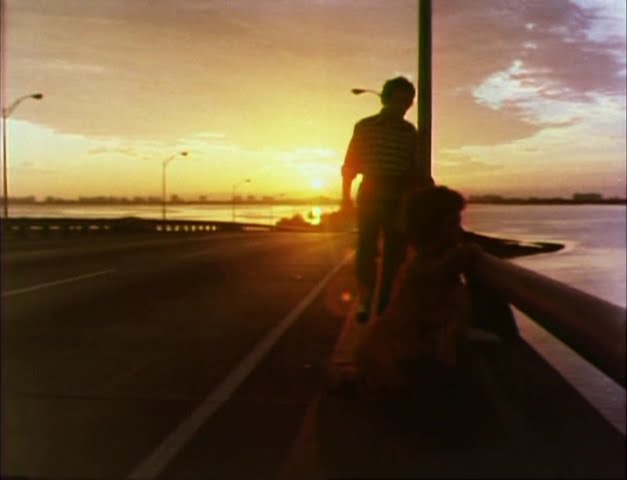
Moments later, in a breath-taking shot on a bridge, Roger meets the film’s other ugly duckling, the unhappy secretary from New York.
“It can’t be real, nothing else is,” the girl says of the Miami Beach sunset, but the lovers discover that some things are quite real. As the romance blooms, Avildsen’s mood grows softer and warmer.
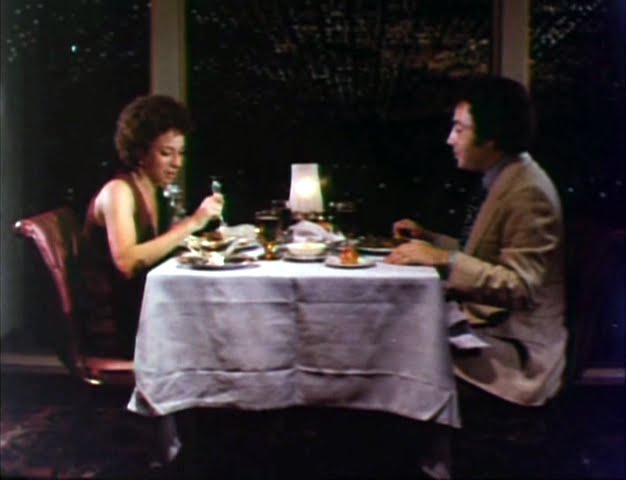
He guides the lovers through the rain at Vizcaya, a romp at Parrot Jungle, a trip to the track, a glittering Beach supperclub.
The film grows serious, the treatment of Florida more gentle. And we now see Mason emerge as a first-rate dramatic actor. “But what if the phony part on the outside is real?” Roger stammers when the girl tells him to bring out his real self.
The first bedroom encounter between the two lovers is equally touching. The acting and dialogue is subdued, like so much of “The Stoolie.” The lovers are hesitant, the faces seen in half-shadow. The moves are awkward and vulnerable.
In a way, we are almost sorry to see the detective arrive to turn this touching tale into an altogether different film (the three try to recoup the money Roger has spent) about cops and robbers and dope and money, subjects we’ve had more than enough of elsewhere.