World Premiere - November 29, 1961 - Kittanning, PA
The Beyond Leone spaghetti western series we co-hosted at 92Y Tribeca last month certainly renewed our interest in the cinema of Tony Anthony, even if the paying public shared none of our enthusiasm for the wonders of GET MEAN. The West Virginia-born western star's first film as actor/producer/co-writer, FORCE OF IMPULSE (1961), is available from Something Weird and worth picking up if you have any interest in regional filmmaking in general (it was shot independently in Florida) or the careers of Anthony and director Saul Swimmer in particular. Other cast members of note include Robert Alda, J. Carroll Naish, Jody McCrea, and jazz drummer Lionel Hampston, plus an "introducing" credit for young female lead Teri Hope, Playboy's Miss September 1958. The IMDb credits Ms. Hope's birth name as Natalie Hope Ronson, while Wikipedia has it as Natalie Hope Heisburg, but the articles below -- from the world premiere showing in her hometown of Kittanning, Pennsylvania -- all refer to her as Natalie Reisberg. Not surprisingly, the 'local girl makes good' press coverage acknowledges the new stage name and shaves two years off her age while avoiding all mention of her Playboy appearances.
Before HOW THE GRINCH STOLE CHRISTMAS, before A CHARLIE BROWN CHRISTMAS, and even before RUDOLPH THE RED-NOSED REINDEER, there was MR. MAGOO'S CHRISTMAS CAROL, the first animated holiday special made for television, which NBC premiered in the 7:30 - 8:30 p.m. time slot on December 18, 1962. The popularity of this musical Christmas classic (with songs by Jule Styne and Bob Merrill) encouraged United Productions of America (UPA) to develop the prime time animated series THE FAMOUS ADVENTURES OF MR. MAGOO, which debuted on NBC in September of 1964. Six years later, former UPA sales manager Mel Maron was running his own distribution company, Maron Films Ltd., and one of his earliest successes was MR. MAGOO'S HOLIDAY FESTIVAL, a kiddie matinee program consisting of MR. MAGOO'S CHRISTMAS CAROL and a re-edit of LITTLE SNOW WHITE, originally a two-part episode of THE FAMOUS ADVENTURES OF MR. MAGOO that aired on January 2 and 9, 1965. According to the ad above, AIP was handling the release of MR. MAGOO'S HOLIDAY FESTIVAL when it played matinees in the New York tri-state area on December 2 and 3, 1972. Maron brought this G-rated program back to New York screens a few years later when he was the head of Cinema Shares.
Bill Cayton and Jim Jacobs are best remembered today as the managers/promoters behind Mike Tyson's ascension to the World Heavyweight Champion title, but the two were also dedicated film collectors and preservationists who amassed a staggering collection of boxing films (between 17,000 and 26,000 sources claim). Their company The Big Fights, Inc. produced and released boxing documentaries such as A.K.A. CASSIUS CLAY (1970) and MUHAMMAD ALI: SKILL, BRAINS, AND GUTS (1975) and the Academy Award nominated THE LEGENDARY CHAMPIONS (1968) and JACK JOHNSON (1970). Cayton was also instrumental in bringing several Russian animated fantasy and science-fiction films from the Soyuzmultfilm studio to the U.S. (including features that were re-edited to become THE SPACE EXPLORERS and THE FROG PRINCE), as well as the live-action Czech production CESTA DO PRAVEKU (1955), which he reworked into the kiddie matinee favorite JOURNEY TO THE BEGINNING OF TIME (1966). Their Big Fights documentary THE SUPER BLACK CHAMPIONS, probably put together to take advantage of the popular soul cinema movement of the early '70s, opened in one New York theater on January 25, 1974.
This past November, Eclipse/Criterion released the excellent DVD and Blu-ray box set When Horror Came to Shochiku, a collection of four late 1960s horror/sci-fi offerings from the Shochiku Company. One of the films contained in this set -- GOKE, BODY SNATCHER FROM HELL (1968) -- took 10 years to reach U.S. theaters. Here's a newspaper ad for its run in Madison, Wisconsin (as BODY SNATCHER FROM HELL) beginning on May 12, 1978.
Temple of Schlock has teamed up with Wild East Productions and Harry Guerro of Exhumed Films to present "Beyond Leone: Looking Past the Spaghetti Western Cinema of Sergio," a six-film series of lesser-known and rarely screened spaghetti westerns that begins next Wednesday, December 12, at 92YTribeca. Chris Poggiali will introduce all six films, and Wild East's Eric Mache and Westerns...All'Italiana! founder Tim Ferrante will drop by to join him for a couple of the screenings. No digital projection either -- these are actual films (and one is an IB Tech print). The schedule and more details are below.
Wednesday, December 12
7:30pm GET MEAN (1975) - 35mm
Directed by Ferdinando Baldi
Starring Tony Anthony, Lloyd Battista, Raf Baldissarre, Diana Lorys
Friday, December 14
7pm & 9pm
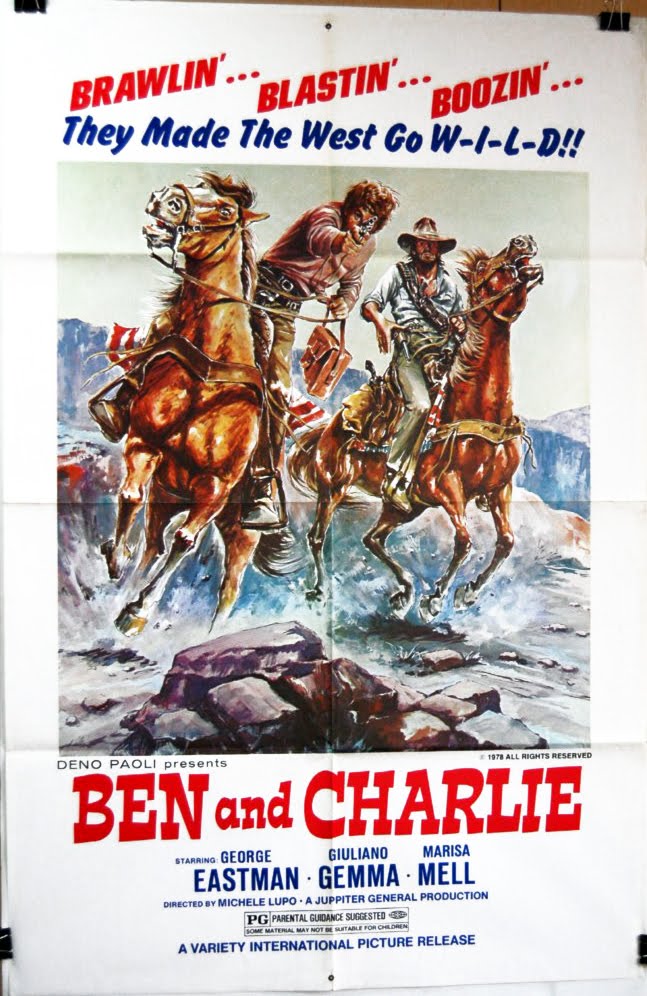
"Spaghetti Western buddy movies" BEN AND CHARLIE (1972) - 35mm
Directed by Michele Lupo
Starring Giuliano Gemma, George Eastman, Giacomo Rossi-Stuart, Marisa Mell
- plus! -
A TRAIN FOR DURANGO (1968) - 35mm (IB Technicolor)
Directed by Mario Caiano
Starring Anthony Steffen, Mark Damon, Enrico Maria Salerno, Aldo Sambrell
Thursday, December 20
7:30pm CUT-THROATS NINE (1972) - 35mm
Directed by Joaquin Luis Romero Marchent
Starring Robert Hundar, Emma Cohen
Saturday, December 22
7pm & 9pm
"Spaghetti Action masters double-bill"
Enzo G. Castellari's KILL THEM ALL AND COME BACK ALONE (1968) 16mm
Starring Chuck Connors, Frank Wolff, Franco Citti
- plus! -
Duccio Tessari's DON'T TURN THE OTHER CHEEK! (1971) - 35mm
Starring Eli Wallach, Lynn Redgrave, Franco Nero
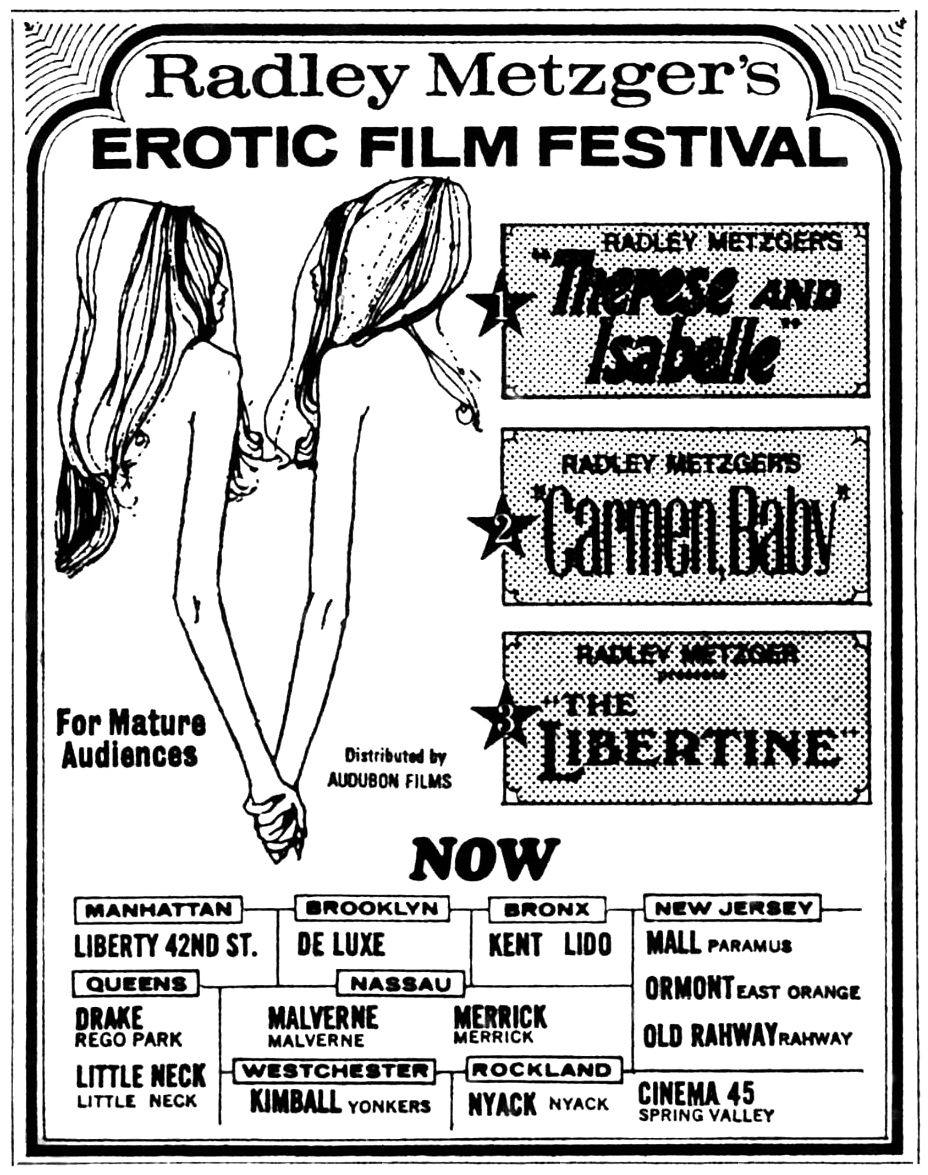
This triple bill of European erotica from Radley Metzger's Audubon Films arrived at 13 theaters in the New York area on October 20, 1972. THERESE AND ISABELLE (1968) and CARMEN, BABY (1967) -- filmed in France and Germany, respectively -- were produced and directed by The Bronx-born Metzger, while THE LIBERTINE (1968), starring Catherine Spaak and Jean-Louis Trintignant, was made in Italy by director Pasquale Festa Campanile and licensed for U.S. distribution by Metzger. Head over to our other blog, The Paperback Film Projector, where you'll find all three represented in a gallery of Radley Metzger paperback covers!
During a “Dog of the Week” segment on Sneak Previews some 30+ years ago, film critic Gene Siskel claimed that THE KINKY COACHES AND THE POM-POM PUSSYCATS contained “the screen’s first unfunny slapstick football game, and they’re always funny.” Evidently Mr. Siskel never suffered through the screen’s first (and only) streaking exploitation comedy, THE STREAK CAR COMPANY, which beat his “Dog of the Week” to theaters by a half dozen years and is never funny. For readers unfamiliar with the act of streaking, or too young to remember its popularity in the mid 1970s, we’re including this link and a brief highlight reel to provide historical perspective.
Ray Stevens' novelty hit “The Streak” reached #1 on Billboard’s Top 100 in 1974. Here he is performing it for understandably befuddled Brits on Top of the Pops.
Rudy Ray Moore recorded a comedy album titled The Streaker.
In the Roger Corman production CANDY STRIPE NURSES (1974), streakers interrupt a basketball game, which inspired this funny tag line at the close of the film’s trailer.
Artist Pedro Bell worked the fictitious “Streaker Liberation Front” into his gatefold sleeve design for Funkadelic’s 1974 album Standing on the Verge of Getting It On.
Most famously, there was David Niven’s unforgettable encounter with streaker-artiste Robert Opel at the 46th Annual Academy Awards.
Believe us when we tell you, THE STREAK CAR COMPANY never gets better than that.
Filmed in Salt Lake City in 1974, at the height of the streaking fad, pic was the second feature by producer-director-cinematographer and occasional actor Paul W. Kener, following the race car documentary ONE SECOND FROM ETERNITY (1971). Eschewing profanity and raunchy humor and limiting all nudity to the non-sexual kind, STREAK managed to squeak past the MPAA with a PG rating, despite an occasional flash of full-frontal flesh. After a 1975-1976 theatrical tour, Kener’s comedy slipped off the radar stateside but resurfaced a decade later in the U.K. thanks to a release on VHS by Renown Video.
Amateurish no-budgeter is set in and around a university identified only as ICU (get it?), where a half dozen brothers of I Phelta Thi (rimshot!) go into business as streakers-for-hire to replenish their fraternity’s depleted funds.
Jim Turner, the fraternity president and injured star quarterback for ICU’s winless football team, is dating Sue Jacobs, president of the sorority next door.
In order to satisfy the demand for female streakers, Sue’s sorority sisters are made equal partners in the Streak Car Company.
But uh-oh! Sue’s father is Dr. Jacobs, president of ICU!
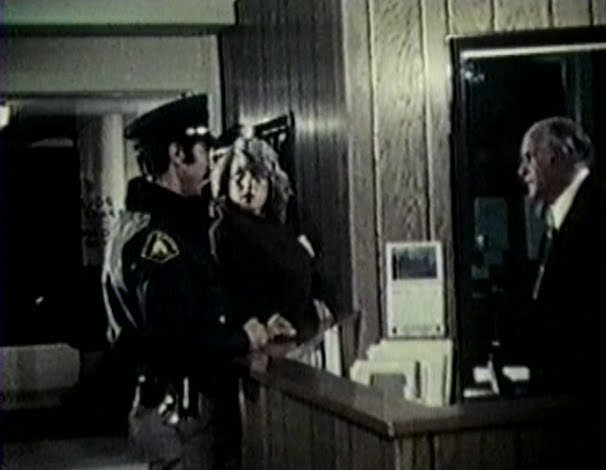
In our favorite scene, Dr. Jacobs threatens to fire the football coach if ICU loses to USC in the big homecoming game. The coach leaves the office…
...…and Stubbs, the school's dean of discipline, enters. Now dressed in a different set of clothes, Dr. Jacobs threatens to fire him if he fails to rid the school of streakers.
From the first frame, STREAK practically shrieks “student film.” Most likely shot on 16mm and blown up to 35mm, it’s doubtful the picture was ever aesthetically pleasing, but the murky film-to-tape transfer certainly doesn’t help. Technical primitivism comes with the territory but poor story structure is a lot harder to forgive; what ultimately kills Kener's sophomore effort is an atrociously plotted script that, barely five minutes into the film's 78-minute running time, has one of the frat brothers exclaim, "That’s it! We’ll form a streaking company!"
To which another frat brother adds, “And we can use Henry’s old Dodge wagon to get there and get back in! And we can rent our streakers out to conventions and parties! ‘You name it, we’ll streak it!’”
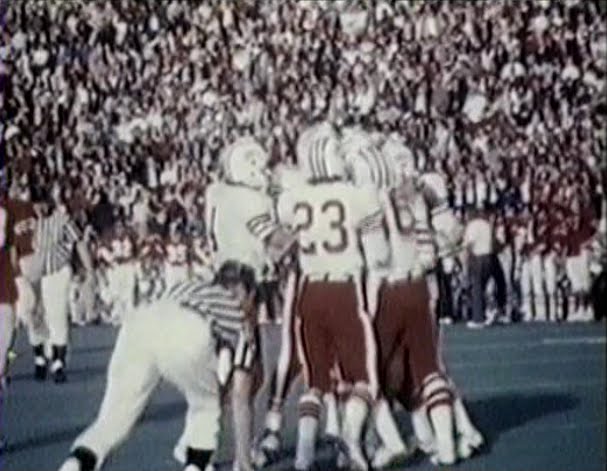
A story this badly frontloaded is guaranteed to tip over and spill everything it has by the 40 minute mark, and THE STREAK CAR COMPANY crashes right on schedule with – get this – the slapstick football game, inexplicably dumped into a nether region between act one and act two.
Every comedy that has ever attempted a setpiece like this, from M*A*S*H to H.O.T.S., was savvy enough to save it for the end of the film, but Kener & Co. trot out the pigskin, the stock footage and the lame Howard Cosell jokes at the midway point for an ineptly shot and edited sequence that brings what little story there is to a screeching halt for 10 long, laughless minutes. Worse, the filmmakers do it without ever convincing us that they’ve actually watched a college football game in their lives.
(Quasi-Schlocko just limped in to remind us that SON OF FLUBBER has a funny football game at its midway point, but we'll leave it up to you to decide which has greater comic potential: flubber gas or bare ass)
The half hour that follows the game is an aimless, stultifying blur that we suffered through three times and still couldn’t piece together into a coherent second and third act.
There’s failed comic shtick between I Phelta Thi’s irritating nerd-in-residence, Whipple, and the chunky, clueless sorority sister Joanie when she attempts to seduce him by dressing up as a harem girl.
Jim and Sue try to make love, but his leg – in a cast because of a football injury – itches too much and keeps distracting him. More hilarity!
Dean Stubbs disguises himself as Dean Stockwell in PSYCH-OUT and steals the Streak Car Company’s profits, which he finds in an unlocked briefcase stashed under the couch in the frat house living room.
Meanwhile, his wife decides to go streaking -– with a gun to our heads we wouldn't be able to tell you why -- and gets herself arrested.
It all leads to a confusing finale in which the members of the Streak Car Company plan to get their cash back by luring Dean Stubbs (in a blonde wig) to a rock concert where he’ll be busted by the police for streaking...or something like that.
As we noted earlier, you can stick a fork in this thing by the 40 minute mark.
That said, THE STREAK CAR COMPANY isn’t a complete waste of time. Fans of low-budget regional filmmaking will still want to check it out, especially if they’re familiar with Kener’s subsequent work in the field...
...which includes photographing the G-rated Sun Classics wilderness flick TOKLAT (1976) and producing/directing a pair of PG-rated horror movies, WENDIGO (1979) and SAVAGE WATER (1980).
And the first act certainly has enthusiasm and forward momentum working in its favor, beginning with an opening credit sequence that spotlights a pair of naked female legs keeping pace with Thom Pace’s “Class Baby Class,” a number worthy of any schlock fan’s Tacky Songs from Trashy Movies mix tape (“You’ve got class baby class/Besides, you’ve got a beautiful ass!”).
First, a disgruntled member of a local women’s auxiliary club hires three of the guys to interrupt the club’s election meeting by running nekkid past the stuffy incumbent and kissing her on the cheek.
Next, sorority sister Joanie is hired to run her chubby nude self through a car wash.
"A car wash?!"
"Streak, baby, streak!"
Kener brazenly defies expectations by letting "the fat girl" handle the nudity in this scene and keeping the slender and more traditionally attractive sorority girls fully clothed.
Likewise, Kener deserves props for including an African-American in I Phelta Thi, even if the guy is named Rah-Rah and talks mostly in rhyme (“It’s exposure with composure!” “Let’s lead him astray and make him pay!”).
Things really pick up when a publicity agent hires two of the girls to parachute naked into the middle of a new shopping center and streak through the grand opening festivities.
Oh, and the Mayor just happens to be there, giving a re-election speech to six unpaid extras.
As with the actor who plays commentator "Coward Wholesale" during the football game, this guy doesn't even try to do impressions of the public figures the scene is superficially poking fun at (JFK and Nixon).
The girls unknowingly jump into the Mayor's car...
...and the next day their stunt makes front page nudes - er, news...
...which infuriates Dr. Jacobs, even though it's never revealed to him that one of the parachuting streakers is his daughter, Sue.
Even Whipple gets into the action when he's forced by his frat brothers to streak through an ICU administrative staff meeting.
While we're on the subject of Whipple, it's important to mention that THE STREAK CAR COMPANY was several years ahead of ANIMAL HOUSE (1978) in its depiction of wacky college fraternities and the introduction of that slob comedy staple known as The Nerd.
Whipple fits the archetype perfectly: skinny, awkward, bespectacled, unfashionable, sexually inexperienced, and cursed with a voice that's as pleasant to the ears as fingernails on a chalkboard.
Similarly, one of the most beloved campus comedies of the '70s -- the aforementioned H.O.T.S. (1979), starring Playboy Playmates Susan Kiger (Miss January 1977) and Pamela Jean Bryant (Miss April 1978) -- is considered to be a sexier knock-off of ANIMAL HOUSE but may have been more influenced by THE STREAK CAR COMPANY. In addition to the football setpiece, it has a topless parachuting scene and an overweight sorority sister who hooks up with a nerd. H.O.T.S just did it funnier and better, with a solid R rating and without an ephemeral gimmick like streaking to stick it with a six-month expiration date.
There's currently no IMDb entry for THE STREAK CAR COMPANY, so we've provided the basic credits below.
THE STREAK CAR COMPANY (1975)
Starring
Roger Darbonne
Richard Jewkes
Shelley Stevensen
Zenda Mensel
Becky Mecham
Karen Youngblood
Ron Ivie
Jer’rise Jennings
Mark Raymound
Reed Rowland
Mark White
James Allen
Larry Burridge
Louise Cannon
Jeff Forward
Don Gust
Clayton Nielson
Wendy Laws
Produced and directed
by
Paul W. Kener
Written by
Brenda Cobia
and
Brent Marshall
Executive Producer
Alma G. Johnson
Director of Photography
Paul Kener
Edited by
Paul Kener
and
Rolf Nordgren
Sound
Rolf Nordgren
Sound Mixer
Hal Hansen
Production Manager
Robert L. Nielson
Make-Up
Arlene Farrell
Sets
Leon Nielson
and
Brenda Cobia
Key Grip
Ray Smith
A
Talking Pictures, Inc.
presentation
Running time: 78 minutes
MPAA rating: PG (1974)
THE STREAK CAR COMPANY is available from Video Screams.